What a Garage Door Spring Actually Does (and Why It Fails)
Most homeowners assume the motor lifts the garage door. It does not. The opener only guides the door and provides a small nudge; the springs carry almost all of the door's weight, which on a typical Sacramento two-car steel door runs between 130 and 200 pounds. The springs store mechanical energy when the door is down and release it to counterbalance that weight as the door rises. When a spring breaks, that counterbalance disappears and the full dead weight of the door lands on the opener, the cables, and gravity.
There are two common systems. Torsion springs mount horizontally on a metal shaft above the door opening and are the standard on most modern Sacramento garages. Extension springs run along the horizontal tracks on either side and are more common on older homes in established neighborhoods like Land Park, East Sacramento, and Carmichael. Both wear out the same way: through cycles. Every open-and-close is one cycle, and a standard spring is rated for roughly 10,000 cycles, which for a busy family door is often only seven to nine years.
Springs fail for predictable reasons. Metal fatigue from normal use is the leading cause, but it is accelerated by a few local realities. Sacramento's wide temperature swings, from foggy 40-degree Delta mornings to 100-plus-degree summer afternoons, make the steel expand and contract repeatedly, which stresses the coils. Rust from winter humidity and irrigation overspray weakens the wire. And an unbalanced or poorly maintained door forces the spring to work harder than it was rated for, shortening its life.
- Springs, not the opener, bear nearly all of the door's weight
- Standard springs are rated around 10,000 cycles, often 7 to 9 years of real use
- Torsion springs sit on a shaft above the door; extension springs run along the side tracks
- Sacramento's heat-to-fog temperature swings accelerate metal fatigue
- Rust from winter damp and sprinkler overspray is a common local culprit
The Telltale Signs Your Spring Is Broken
The clearest sign is sound. A breaking spring releases a tremendous amount of stored tension in an instant, producing a loud bang or pop that many homeowners describe as a firecracker, a gunshot, or something heavy falling in the garage. People often hear it from inside the house and assume something fell off a shelf. If you heard a sharp metallic snap from the garage and the door stopped working afterward, a broken spring is the prime suspect.
The next sign is behavior. With a broken torsion spring, the opener motor will usually run, hum, and strain, but the door barely lifts a few inches before stopping, or it will not move at all. The opener simply is not strong enough to raise the full uncounterbalanced weight. If you pull the manual release cord, the door will feel shockingly heavy, slam down hard, or refuse to stay up when you let go. A healthy door should hold its position roughly halfway up; a door with a broken spring will not.
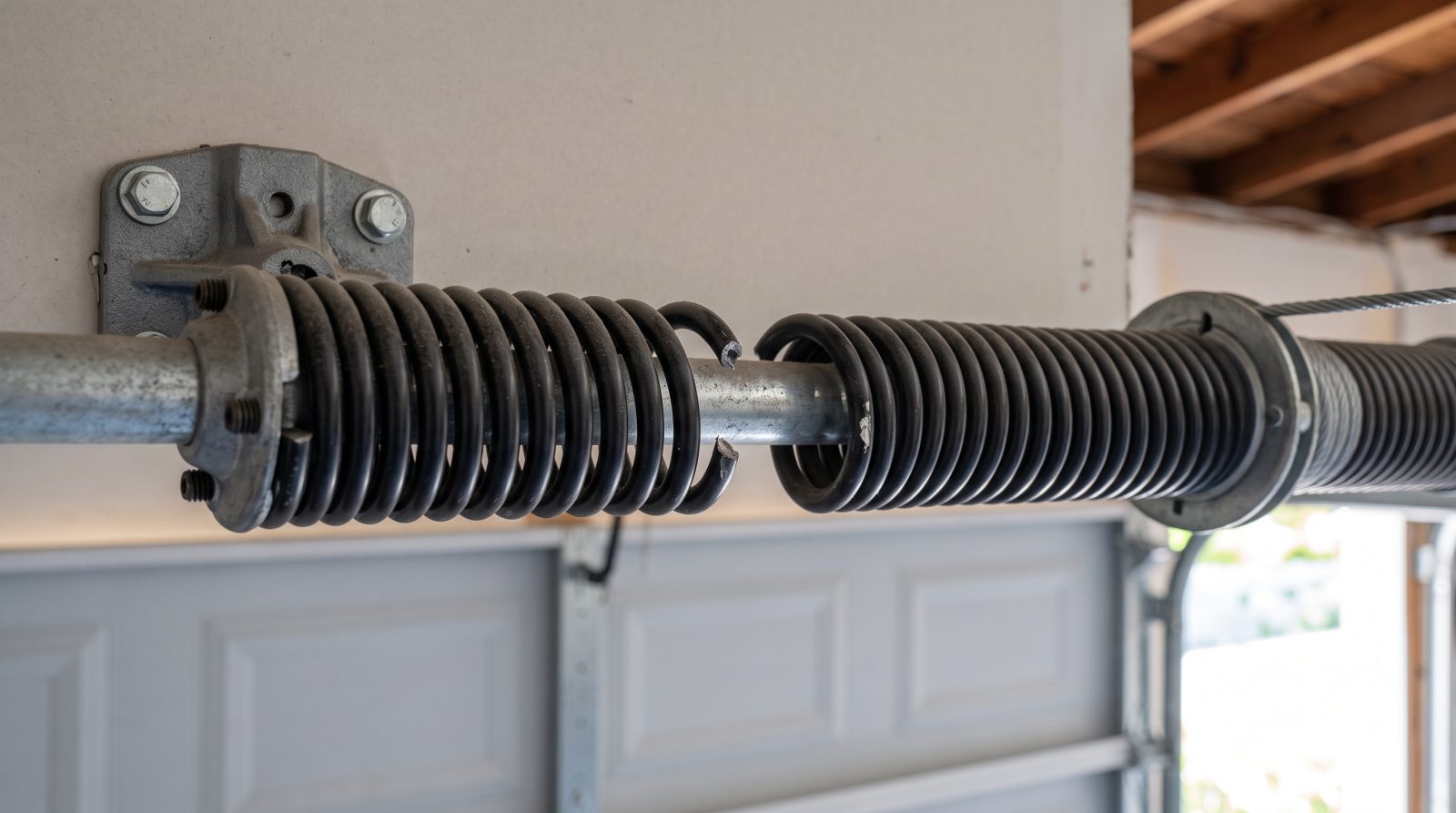
Then there is the visual confirmation, which is the most reliable of all. On a torsion system, look at the spring on the shaft above the door. A broken torsion spring shows a clear two-to-three-inch gap where the coils have separated, and the two ends often look slightly twisted or stretched apart. On an extension system, you may see a spring hanging loose, a stretched-out coil, or one side of the door sitting higher than the other. Crooked or uneven door movement is another giveaway, since one working spring can no longer balance the load by itself.
- A loud bang or pop from the garage, often mistaken for a gunshot or falling object
- The opener runs and strains but the door rises only a few inches or not at all
- A visible 2 to 3 inch gap in the coils of a torsion spring above the door
- The door feels extremely heavy on the manual release and will not stay open
- The door rises crooked, sticks, or one side hangs lower than the other
Broken Spring or Something Else? How to Tell the Difference
Not every dead garage door is a spring problem, and guessing wrong wastes time and money. The fastest way to separate a spring failure from an opener or electrical issue is to look at where the failure points. If the opener's lights and remote work normally and the motor runs but the door will not lift, the springs are almost certainly the issue. If the opener is completely silent and unresponsive, you are more likely looking at a power, logic board, or wiring problem, which is common during summer brownouts on the Sacramento grid.
A door that is off its track or has a broken cable can mimic a spring problem because both leave the door stuck and crooked. The difference is what you see: a derailed roller or a frayed, dangling cable points to track or cable trouble, while a clean gap in the spring coils points squarely at the spring. It is also worth knowing that when one spring breaks on a two-spring door, the second is usually near the end of its life too, since both were installed together and have run the same number of cycles.
Here is a simple, safe check you can do without touching anything under tension. With the door fully closed, pull the manual release cord and try to lift the door by hand a foot or two. If it glides up smoothly and holds where you leave it, your springs are fine and the problem is elsewhere. If it feels like dead-lifting a refrigerator or it crashes back down, stop immediately and leave it closed. That weight is exactly why a broken spring is dangerous to work around, and it is the clearest confirmation that a spring has failed.
- Opener runs but door won't lift = spring; opener totally dead = power or board
- A frayed, hanging cable or a derailed roller points to track or cable, not spring
- A clean coil gap in the spring is the definitive sign of spring failure
- When one spring breaks on a two-spring door, the other is usually due soon
- Manual-lift test: smooth and holds = springs OK; very heavy or slams = spring broken
Why a Broken Spring Is Not a DIY Fix
It is tempting to order a replacement spring online and swap it yourself, but garage door springs are one of the genuinely hazardous repairs in a home. A torsion spring is wound under several hundred pounds of stored tension, and releasing or winding it incorrectly can cause the winding bars to whip free or the spring to unwind violently. This is a leading cause of serious hand, face, and eye injuries among DIYers, and it is the reason professionals use specific winding bars, properly sized springs, and a careful sequence.
Sizing is the other trap. Springs must be matched to your door's exact weight, height, and drum size, and a spring that is even slightly off will leave the door unbalanced. An unbalanced door wears out its replacement spring early, strains the opener, and stresses the cables and rollers, turning one repair into several. Many homes also have two springs that should be replaced as a matched pair so the door stays balanced and both last the same length of time.
Because we are a mobile operation, the safest and fastest path in Sacramento is to have the repair done on site by someone who measures your door, brings the correct springs and tools to your driveway, and balances the door before leaving. There is no need to remove the door, haul anything to a shop, or wait days for parts. If you have a broken spring, leave the door closed, keep kids and cars clear of it, and request a free quote so it can be handled properly the first time.
- Torsion springs hold hundreds of pounds of tension and can injure inexperienced hands
- Wrong spring size leaves the door unbalanced and shortens the new spring's life
- An unbalanced door also wears out the opener, cables, and rollers prematurely
- Two-spring doors should be replaced as a matched pair for even wear
- Mobile service comes to your driveway with the right springs and tools, no shop trip
What to Expect From a Mobile Spring Repair in Sacramento
When you call about a broken spring, the first step is a quick diagnosis to confirm it is the spring and not a cable, track, or opener issue. Because we come to you, that inspection happens at your home, whether you are in Natomas, Elk Grove, Folsom, Roseville, or central Sacramento. Confirming the real cause up front means you are not paying to replace a part that was not broken.
Spring replacement itself is typically a same-day job once the correct springs are on hand. A technician measures the door, installs the matched springs, winds them to the proper tension, and then balances the door so the opener is doing only its small share of the work. A good repair always ends with testing the door through several full cycles and checking that it holds position halfway, which is the proof that the counterbalance is set correctly.
On cost, treat any figure as a labeled industry range rather than a quote, since the price depends on whether you have a one-spring or two-spring door, the spring size, and the door weight. As a general guide, two-spring matched-pair replacements typically sit at the higher end of the range. The honest answer for your specific door comes after the door is measured, which is exactly what a free quote is for. If your door is showing any of the signs above, the safest move is to stop using it and request a free quote today.
- On-site diagnosis confirms it is the spring before any parts are replaced
- We come to you across the Sacramento area, from Natomas to Elk Grove to Folsom
- Spring replacement is typically a same-day repair once the right springs are on hand
- The job ends with door balancing and a multi-cycle test so the opener is not overworked
- Costs are labeled ranges only; a measured free quote gives the real number for your door