Start With How You Actually Use the Garage
Before you compare brochures, look at how your garage works day to day, because that single fact drives almost every other choice. A door that's perfect for a detached storage garage in the back of a Curtis Park lot is the wrong door for an attached, finished garage that doubles as a home gym in Natomas. The use case decides how much you should spend on insulation, weather sealing, and quiet operation.
In the Sacramento area we see three common patterns. First, the purely functional garage that just parks cars and holds tools — here durability and security matter more than R-value. Second, the attached garage that shares a wall with the living space, common in Roseville, Folsom, and Elk Grove tract homes, where heat transfer in July directly raises your cooling bill. Third, the converted or semi-converted garage used as an office, workshop, gym, or teen hangout, where insulation, sealing, and a quiet motor become non-negotiable.
Also factor in orientation. A west- or south-facing door in the Valley takes brutal afternoon sun from spring through October. That sun fades finishes, bakes uninsulated steel, and stresses springs and seals over time. If your door faces the afternoon sun, lean toward lighter colors, factory-baked finishes, and better insulation than you'd otherwise buy.
- Detached/utility garage: prioritize durability, security, and a clean look over high insulation
- Attached garage sharing a living wall: insulation and weather sealing pay you back on cooling costs
- Converted gym/office/shop: insulation, tight seals, and a quiet belt-drive opener matter most
- West/south-facing door: choose fade-resistant finishes and step up the insulation for afternoon sun
Compare the Main Garage Door Materials
Material is the decision that affects price, maintenance, lifespan, and how the door handles Sacramento's heat and dust. There's no single best choice — each material trades cost against durability and looks. Here's how the common options actually perform in the Valley.
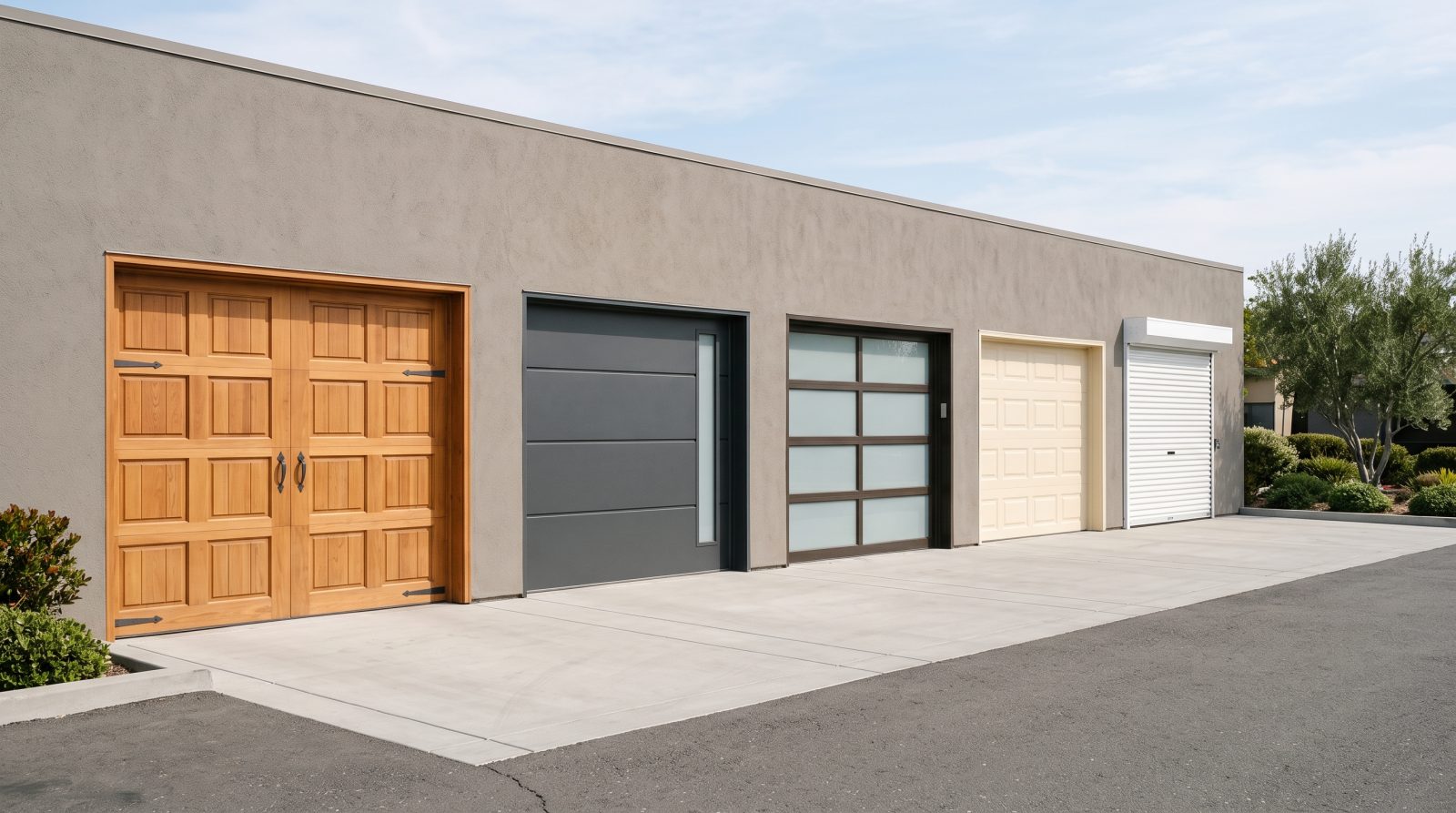
Steel is the workhorse of Sacramento garages, and for good reason. Insulated, multi-layer steel resists warping in the heat, needs little upkeep, and comes in finishes that mimic wood without the maintenance. Single-layer steel is cheaper but dents easily and offers almost no insulation, so on an attached garage it's usually a false economy. Aluminum with glass (full-view) doors look striking on modern homes in midtown and newer infill builds, are rust-resistant and light, but the frames dent more easily and large glass sections gain heat fast unless you specify tinted or insulated glazing.
Wood and wood-composite doors deliver unmatched character on Craftsman, Tudor, and ranch homes in East Sacramento, Land Park, and the Fab 40s. Real wood is beautiful but demands refinishing every few years — and our dry summers and UV are hard on it. Composite and faux-wood overlays give you that carriage-house look with far less upkeep, which is why many homeowners in design-conscious neighborhoods choose them. Fiberglass and vinyl are niche here: fiberglass resists dents and salt but can yellow and crack with sustained UV, while vinyl is dent- and rust-proof and very low-maintenance, though style options are limited.
- Insulated steel: best all-around value for the Valley — durable, low-maintenance, many finishes
- Single-layer steel: lowest cost but dents and offers little insulation; avoid on attached garages
- Aluminum + glass (full-view): modern look, rust-resistant, but specify insulated/tinted glass for heat
- Wood: stunning on Craftsman/Tudor homes but needs regular refinishing in our UV and dry air
- Composite/faux-wood: the carriage-house look with far less maintenance than real wood
- Fiberglass/vinyl: dent- and rust-resistant, low-maintenance, but fewer style options and possible UV yellowing
Match the Style to Your Home and Street
Because the garage door can cover a third or more of your home's street-facing facade, style is not a cosmetic afterthought — it's the single biggest visual upgrade most Sacramento homeowners can make. The goal is a door that looks like it belongs, both to your house's architecture and to the rhythm of the block.
Three style families cover most local homes. Traditional raised-panel and flush doors suit the vast stock of mid-century and tract ranch homes across Carmichael, Citrus Heights, and Rancho Cordova; they're clean, affordable, and timeless. Carriage-house (carriage-style) doors, with their swing-out look and decorative hardware, complement Craftsman, Spanish, and farmhouse homes in older neighborhoods and add a lot of curb appeal on a remodel. Contemporary doors — flush panels, horizontal lines, and full-view glass — pair with the modern and infill builds going up around midtown and the streetcar suburbs.
Two practical notes for our area. If you live in a master-planned or HOA community in Elk Grove, Folsom, Roseville, or Lincoln, confirm approved colors and styles before you fall in love with an option; many HOAs restrict door appearance. And think about window placement: glass adds light and style but also adds afternoon heat and a sightline into the garage, so on a west-facing door consider frosted or high-set windows.
- Traditional raised-panel/flush: ideal for ranch and tract homes; affordable and timeless
- Carriage-house: best curb-appeal boost for Craftsman, Spanish, and farmhouse styles
- Contemporary flush/full-view glass: matches modern midtown and infill builds
- HOA communities (Elk Grove, Folsom, Roseville, Lincoln): verify approved styles/colors first
- Windows: great for light, but use frosted or high-set glass on hot, west-facing doors
Understand Insulation and R-Value for the Valley Heat
Insulation is where Sacramento's climate changes the math compared to milder coastal areas. Our summers regularly push past 100°F, and an uninsulated garage can become an oven that radiates heat into the rooms behind it all evening. If your garage is attached or used as living space, insulation is the upgrade with the most real-world payoff — both in comfort and on your summer cooling bill.
Insulation is measured as R-value: the higher the number, the more it slows heat transfer. As a rough guide, a detached utility garage may be fine with little to no insulation; an attached garage sharing a wall with the house benefits from a mid-range insulated door; and a garage you actually spend time in — a gym, office, or shop — justifies the highest R-value you can get, paired with insulated walls and a sealed garage-to-house door. Construction matters as much as the headline number: a double-layer (steel-insulation-steel) sandwich door is dramatically stronger and quieter than a single skin with a foam panel glued on.
Insulation does more than fight heat. It stiffens the door so it resists denting and warping, it dampens the rumble of the opener so a converted room stays quiet, and the better weather seals that come with insulated doors keep out the fine Valley dust and pollen that otherwise coats everything in the garage. Don't forget the bottom and side seals — even a great door leaks comfort and dust if the perimeter seals are worn or the threshold doesn't sit flush.
- Detached utility garage: minimal insulation is usually fine
- Attached garage on a living wall: choose a mid-range insulated door to cut summer heat transfer
- Garage as gym/office/shop: go for the highest practical R-value plus a sealed house door
- Look for double-layer (steel-foam-steel) construction — stronger, quieter, and far better insulated
- Insulation also reduces denting, cuts opener noise, and the seals block Valley dust and pollen
- Replace worn bottom and side weather seals so the perimeter doesn't undo the door's R-value
Set a Realistic Budget (and What Drives the Cost)
Garage door pricing varies widely, so it helps to think in ranges rather than a single number, and to understand what actually moves the price. The figures below are general industry ranges to help you plan — not a quote — and your real number depends on size, material, insulation, windows, hardware, and the condition of your existing opening. We'll give you an itemized price after seeing the door in person.
As a planning framework: a basic single-layer steel door on a standard single-car opening sits at the low end; an insulated steel door — the sweet spot for most Sacramento homes — sits in the mid range; and premium full-view glass, custom carriage-house, or real-wood doors reach the high end, especially in two-car widths. Add-ons that raise the price include windows, decorative hardware, upgraded insulation, smart Wi-Fi openers, and heavier-duty springs sized to the door's weight. Removal and disposal of the old door, and any repair to the frame or tracks, can also affect the total.
The smartest way to budget is to weigh upfront cost against how long you'll stay and what you'll save. If you're selling soon, a clean mid-range door with strong curb appeal is usually the best return. If this is your long-term home with an attached, conditioned garage, spending more on insulation and a quality opener pays you back in comfort, quieter operation, and lower cooling costs over the years. Because we're a mobile, we-come-to-you operation across the Sacramento area, you can get measured and quoted in your own driveway — no showroom trip required. When you're ready, call or request a free quote and we'll give you honest options at several price points.
- Treat all prices as planning ranges — your itemized quote comes after an on-site measure
- Lower range: basic single-layer steel on a standard single-car door
- Mid range: insulated steel — the practical sweet spot for most Sacramento homes
- Higher range: full-view glass, custom carriage-house, and real-wood doors (especially two-car widths)
- Cost drivers: size, insulation level, windows, decorative hardware, smart opener, and spring weight rating
- Don't forget old-door removal/disposal and any frame or track repair in your budget
- Selling soon? Prioritize curb appeal. Staying long-term with an attached garage? Invest in insulation and a quiet opener