Mobile Garage Door Repair, Brought to Your Driveway
Because we operate as a mobile service rather than from a storefront, the entire repair happens at your home. A technician arrives in a stocked vehicle, confirms the symptoms you described, and carries out a full safety check of the door before touching a single component. That matters with garage doors more than almost any other home repair, because a residential door is under enormous spring tension and a misdiagnosed fix can turn a minor issue into a dangerous one.
For Sacramento households, mobile service solves a very practical problem: the garage is often the main way in and out of the house. In newer Natomas, Elk Grove, and Roseville builds especially, the attached two- or three-car garage is the everyday entrance, so a door that will not open can effectively lock a family out of their own routine. Coming to you means the car, the house, and your day get unstuck on the same visit instead of waiting on a drop-off and pickup.
We service the City of Sacramento and the surrounding communities, including Elk Grove, Folsom, Roseville, Rancho Cordova, Citrus Heights, Carmichael, Natomas, and the older central neighborhoods like Land Park, Curtis Park, and East Sacramento. Whether the door is a modern insulated steel sectional or a vintage unit on a 1940s bungalow, we work on it where it stands.
- We come to you anywhere in the Sacramento service area, no shop drop-off required
- Stocked service vehicle carries common springs, rollers, cables, and opener parts
- Full safety inspection of the door, springs, and tracks before any repair
- Same-day mobile appointments available for most common failures
- Honest diagnosis on site, so you are not guessing at what is actually wrong
Common Garage Door Problems We Fix
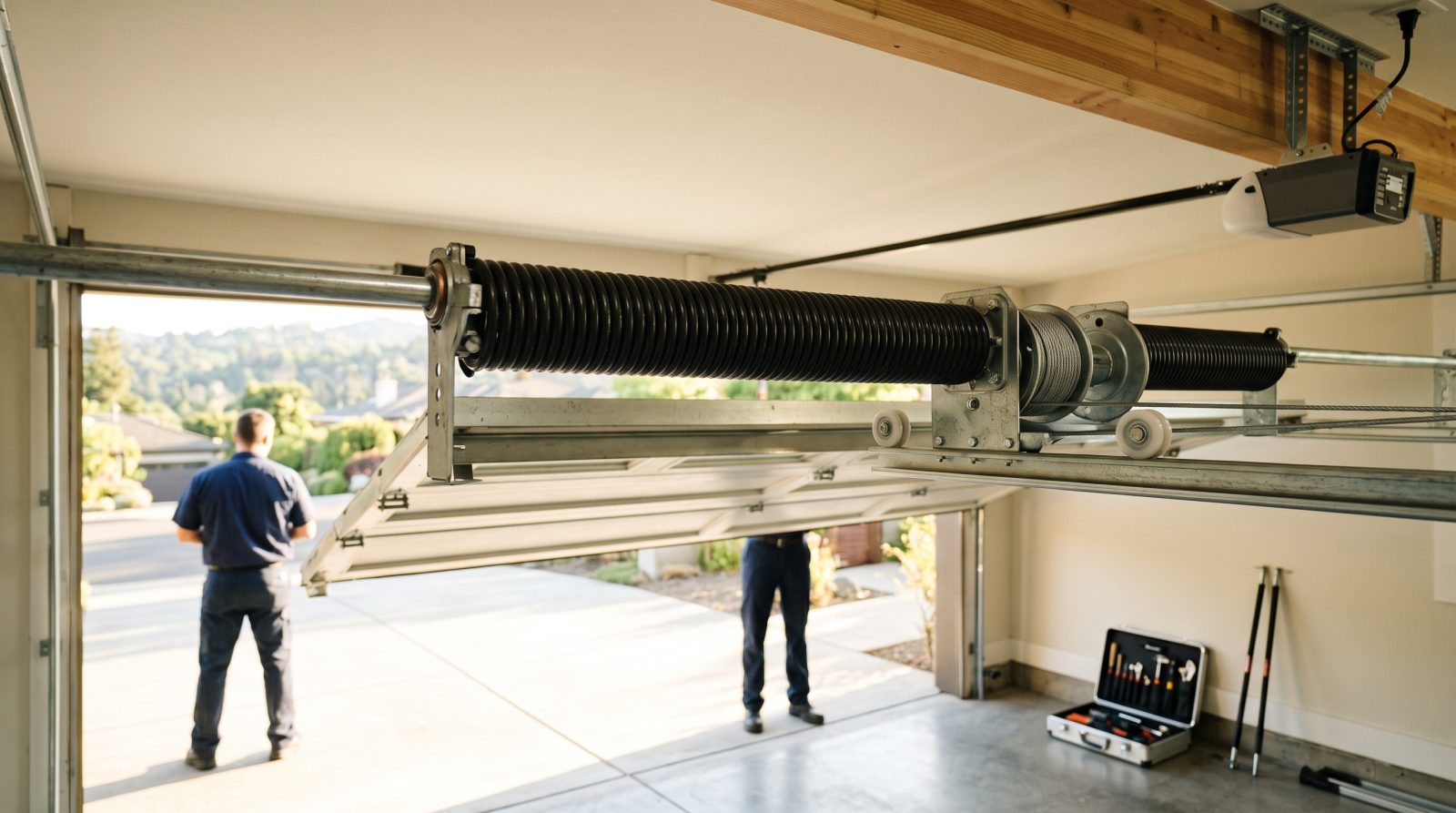
Most garage door failures fall into a handful of repeatable categories, and recognizing the symptom early often prevents a bigger repair. The single most common emergency is a broken torsion or extension spring. Springs do the heavy lifting that lets the opener raise a 150-plus-pound door, and they are wound under high tension. When one breaks you may hear a loud bang from the garage, see a visible gap in the coil, or find the door suddenly far too heavy to lift and the opener straining or refusing to move it. A broken spring is not a DIY job because of the stored energy involved, and it is the repair we are called for most often.
Cables, rollers, and tracks are the next cluster. Frayed or snapped lift cables can leave a door hanging crooked or jammed, and worn nylon or steel rollers cause the grinding, shuddering, and jerky travel many homeowners learn to ignore until the door finally binds. A door that has come off track, often after a roller fails or something bumps the rail, will sit visibly tilted and should not be forced; running the opener against an off-track door can bend the tracks and multiply the damage.
Openers are the third major category. A unit that hums but will not move, responds to the wall button but not the remote, reverses immediately after closing, or has simply gone silent can be suffering from anything from a stripped drive gear to misaligned safety sensors or a failed logic board. Many opener complaints are actually sensor problems, where the two photo-eyes near the floor are dirty, knocked out of alignment, or blocked, which is exactly the kind of thing a Sacramento garage full of dust and stored gear tends to cause.
- Broken torsion and extension springs (loud bang, door too heavy, opener strains)
- Frayed or snapped lift cables and doors hanging crooked
- Worn rollers and bent tracks causing grinding, shaking, or binding
- Doors off their tracks and sitting tilted or jammed
- Openers that hum without moving, ignore the remote, or reverse on closing
- Misaligned or dirty safety sensors stopping the door from closing
- Noisy operation, sagging sections, and doors that stop partway
Why Sacramento Garage Doors Wear Out the Way They Do
Sacramento's climate puts a specific kind of stress on garage doors, and understanding it helps explain the repairs we see. Summers in the Central Valley regularly push well past 100 degrees, and an attached garage with a west- or south-facing door becomes one of the hottest spaces in the house. That heat makes metal panels expand and contract, dries out lubrication on springs and hinges, and can bake the rubber bottom seal until it cracks and stops keeping heat, dust, and pests out. The strong daily swing between hot afternoons and cool Delta-breeze evenings only accelerates that expansion-and-contraction cycle.
Dust and fine valley grit are the quieter culprits. Sacramento driveways and the surrounding ag-adjacent areas kick up a lot of airborne dust that settles into tracks and onto rollers, and combined with dried-out lubricant it turns smooth travel into a grinding, stop-start crawl. Hard water and dust together can also corrode and gum up moving parts faster than many homeowners expect.
Then there is the age of the housing stock. Central neighborhoods like Land Park, Curtis Park, East Sacramento, and Oak Park have plenty of older homes with original or long-serving doors, lighter hardware, and aging or even manual openers that were never built for daily modern use. At the same time, the high-cycle reality of newer Elk Grove, Folsom, and Roseville homes, where the garage door is opened and closed many times a day as the primary entrance, wears springs and openers out on a predictable timeline. Different neighborhoods, different failure patterns, same underlying physics.
- Triple-digit valley summers expand metal panels and dry out lubrication
- West- and south-facing doors take the worst of the afternoon heat
- Valley dust and grit clog tracks and rollers, causing grinding and binding
- Cracked bottom seals let heat, dust, and pests into the garage
- Older central-neighborhood doors run lighter, aging hardware
- High-cycle suburban garages wear springs and openers on a faster clock
What to Expect From a Repair Visit
A good repair starts with diagnosis, not parts. When the technician arrives, they confirm what you have been seeing and hearing, then test the door's balance, springs, cables, rollers, tracks, and opener as a system, because garage door problems often cascade. A failing roller can throw a door off track, an off-track door can fray a cable, and a tired spring can make a perfectly good opener look broken. Checking the whole system means the actual root cause gets fixed, not just the loudest symptom.
Once the problem is identified, you get a clear explanation of what failed, why, and the options to address it, along with honest, plain-English pricing before work begins. Garage door pricing varies with the part, the door's size and weight, and whether components must be replaced in matched pairs, so any figures you see described online should be treated as general industry ranges rather than a quote. The only accurate number for your door is the one given after the door has actually been looked at. Many common repairs, such as spring replacement, roller and cable work, sensor realignment, and a range of opener fixes, can be completed in the same visit because the vehicle carries the usual parts.
For your safety and the door's longevity, we never force a compromised door to keep operating, we replace springs and cables in proper pairs when balance requires it, and we finish by re-testing the door's balance and the opener's auto-reverse safety feature so the door is genuinely safe to use, not just moving again. If a door is too old or too damaged to repair sensibly, we will tell you that honestly rather than sink money into a losing fix.
- Full system diagnosis before any parts are quoted or replaced
- Plain-English explanation of what failed and why
- Clear pricing presented before the work starts, never a surprise
- Most common repairs completed on the same mobile visit
- Springs and cables replaced in matched pairs when balance demands it
- Door balance and auto-reverse safety re-tested before we leave
Keeping Your Garage Door Healthy Between Visits
Garage doors give plenty of warning before they fail, and a little attention goes a long way in the Sacramento climate. The cheapest insurance is lubrication: a few times a year, a proper garage-door lubricant on the springs, hinges, and rollers counteracts the heat and dust that dry everything out, and it quiets a noisy door at the same time. Avoid heavy grease, which actually attracts the valley dust you are trying to keep out.
Listen and watch as you use the door. New grinding, popping, or a door that shudders, stops partway, or hesitates is the early stage of a roller, cable, or spring problem, and addressing it then is far simpler than after the part lets go. A quick monthly balance test tells you a lot: with the door closed, disconnect the opener using the red release cord and lift the door by hand to about waist height. A healthy, properly sprung door will stay roughly in place; one that slams down or shoots up is poorly balanced and is overworking both the springs and the opener.
Test your safety features too, because they protect children, pets, and cars. Place a roll of paper towels or a block of wood under the open door and close it; a correctly working door must reverse the moment it touches the object. If it does not, the auto-reverse or the floor-level safety sensors need attention right away. None of this replaces a professional check, but it helps you catch trouble while it is still a quick mobile fix rather than a door stuck shut on a 105-degree afternoon.
- Lubricate springs, hinges, and rollers a few times a year with garage-door lubricant
- Skip heavy grease, which traps Sacramento's airborne dust
- Treat new grinding, popping, or hesitation as an early warning, not background noise
- Run a monthly hand-balance test using the red release cord
- Test auto-reverse by closing the door onto a solid object
- Call early for small symptoms so they stay small and same-day-fixable