Why Insulation Matters More in Sacramento Than Almost Anywhere
Sacramento's climate is uniquely tough on garages. Summer afternoons routinely push past 100 degrees, and a west- or south-facing garage door sits in full valley sun for hours, turning a single-layer steel door into a giant radiator that dumps heat into the bay and the rooms behind it. Then the delta breeze rolls in at night and temperatures can drop sharply by morning, so the same uninsulated door that cooked all day now leaks the cool right back out. That daily swing is exactly what insulation is built to smooth out.
Most Sacramento homes have an attached garage, and many have living space directly above it or beside it, a bonus room, a home office, an upstairs bedroom, or a converted garage gym or workshop. Heat that builds up in an uninsulated bay doesn't stay put; it migrates through the shared wall and ceiling, making your air conditioner work harder during the very hours that time-of-use electricity rates are typically highest. An insulated door reduces that heat transfer at the source, which is far more effective than trying to cool the problem away after it has already entered the house.
There's also a comfort and usability angle that homeowners feel immediately. If your garage is where you do laundry, park a daily driver, store anything heat-sensitive, or actually spend time, an uninsulated door makes that space close to unusable on the hottest and coldest days. An insulated door keeps the bay meaningfully closer to a livable temperature, so the garage becomes a room you can use year-round instead of one you avoid through the peak of summer.
R-Value Explained: What the Number Means (and What It Doesn't)
R-value measures how well a material resists heat flow, and the higher the number, the better the insulation. Garage doors are commonly sold with R-values ranging from the low single digits for a basic vinyl-backed door up to the high teens or low twenties for premium multi-layer doors. As a rough map: non-insulated steel doors offer essentially no thermal resistance, entry-level insulated doors land in the mid-single digits, mid-range polyurethane doors commonly sit in the low-to-mid teens, and the top residential doors reach the high teens or beyond.
Here's the honest part most ads leave out: the advertised R-value usually describes the insulation core at its thickest point, not the whole door as installed. Real-world performance also depends on the door's seals, the section joints, how well the door fits the opening, and whether the garage walls and ceiling are insulated at all. A high R-value door on a leaky, sun-blasted, otherwise-uninsulated garage will still help, but it won't perform like the brochure number in isolation. Treat R-value as a useful comparison tool between doors, not as a guaranteed energy bill.
For most Sacramento homes, the sweet spot is a mid-range insulated door rather than the absolute maximum. The jump from no insulation to a solid mid-teens R-value door delivers the lion's share of the comfort and efficiency gain. Going from there to the very top tier costs more for smaller incremental returns, and that money is often better spent on good weather seals and addressing the garage envelope. We'll walk your specific garage and tell you honestly where the meaningful threshold is for your situation.
- Non-insulated steel: minimal thermal resistance, lowest cost, loudest
- Entry-level insulated (vinyl/polystyrene backing): mid-single-digit R-value range
- Mid-range polyurethane core: low-to-mid teens R-value range, the common sweet spot
- Premium multi-layer (sandwich) construction: high teens and up, quietest and most rigid
- Advertised R-value reflects the core, not the whole installed door, seals and fit matter too
Polystyrene vs. Polyurethane: How Insulated Doors Are Built
Insulated garage doors come in two main constructions, and the difference is more than a number on a label. Polystyrene-insulated doors use rigid foam panels cut and slotted into the door sections. They are a clear step up from a hollow door, cost less, and suit a garage that's detached or where you mainly want to knock down noise and the worst of the heat. Because the foam is set into the sections rather than bonded throughout, the thermal performance and rigidity are good but not the highest available.
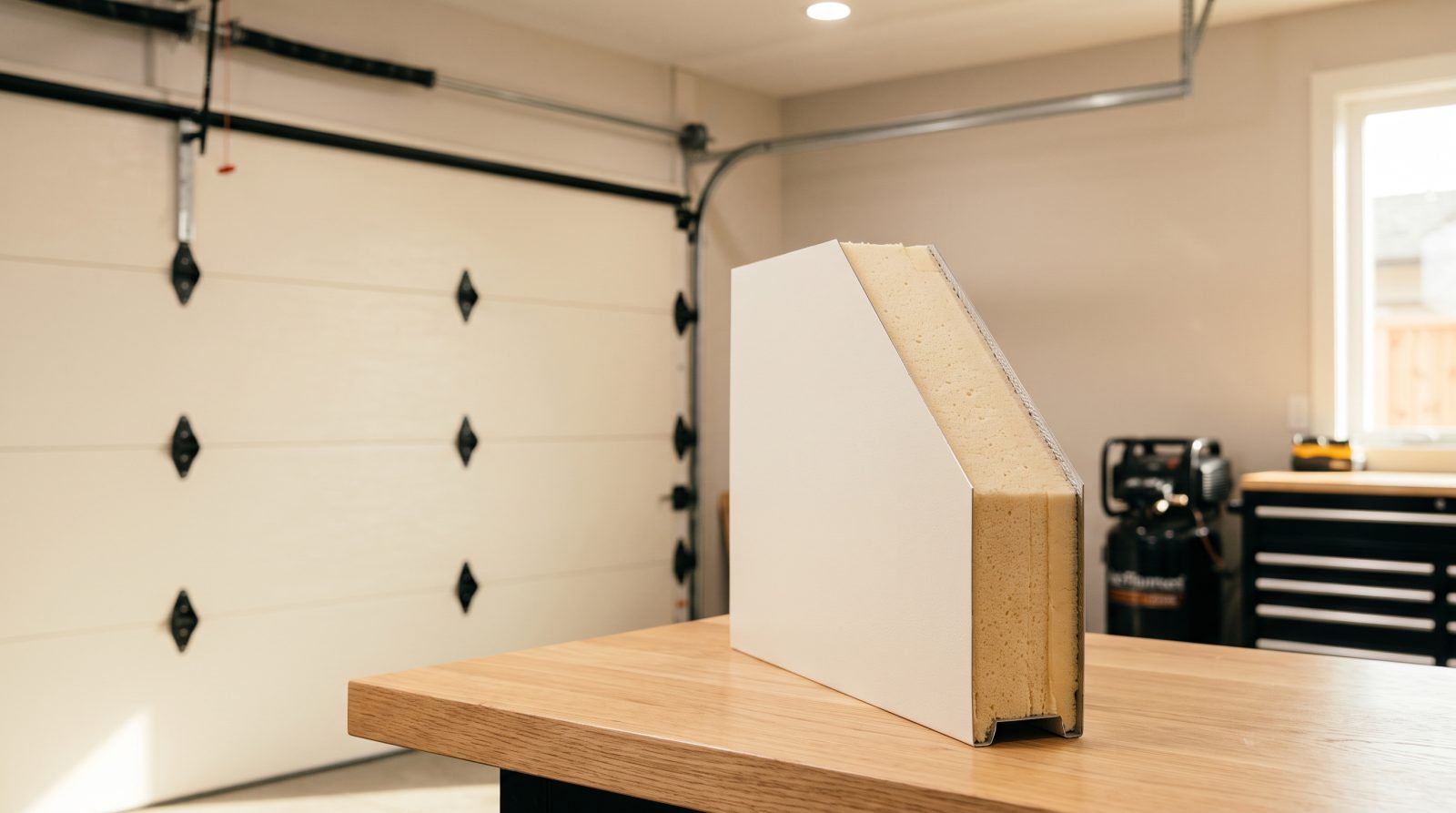
Polyurethane-insulated doors are made by injecting expanding foam between the steel skins, where it bonds to both layers and fills the section completely. This produces a denser core, a higher R-value for the same thickness, a stiffer and stronger door, and noticeably better sound dampening. For Sacramento's heat load and for any garage attached to living space, polyurethane is usually the better long-term choice, it resists dents better, holds its shape in heat, and the bonded core won't sag or settle over the years the way loose-fit foam panels eventually can.
Door layers are another way to read quality. A single-layer door is just steel. A two-layer door adds insulation behind the steel. A three-layer, or sandwich, door encloses the insulation between an outer and inner steel skin, which is the most durable, quietest, and best-insulating residential build. If your garage faces afternoon sun, sits under a bedroom, or doubles as a workspace, the three-layer polyurethane door is the upgrade that pays you back in comfort every single day.
- Polystyrene (panel): good value, decent noise and heat control, best for detached or budget builds
- Polyurethane (injected foam): higher R-value per inch, stronger, quieter, better for attached garages
- Two-layer: steel plus insulation, an insulated back is exposed
- Three-layer (sandwich): insulation sealed between two steel skins, most durable and quietest
- Bonded polyurethane resists sagging and heat distortion better over the years
The Energy, Comfort, and Resale Payoff
The most reliable benefit of an insulated door in Sacramento is comfort you can feel the same day it's installed. The garage runs cooler in summer and warmer in winter, the temperature stops swinging as wildly between the afternoon peak and the morning low, and any room sharing a wall or floor with the garage becomes easier to keep comfortable. If you have an upstairs room over the garage, this is often the difference between that room being usable in late summer and being abandoned until the weather cools.
On the energy side, the gains are real but worth framing honestly. An insulated door reduces the heat your cooling system has to fight during peak afternoon hours, which is exactly when electricity is most expensive on time-of-use plans. How much you save depends on your garage's exposure, how much living space it touches, how well-sealed and insulated the rest of the garage is, and your own thermostat habits. We won't promise a specific dollar figure, but reducing a major heat-entry point during peak-rate hours is a sound, lasting efficiency move rather than a gimmick.
Beyond utility bills, insulated doors are quieter, sturdier, and more attractive, all of which matter at resale in a competitive Sacramento market. The thicker construction dampens street noise and the bang-and-rattle of the door itself, the rigid sections dent less and operate more smoothly, and a clean modern insulated door noticeably improves curb appeal. For homeowners weighing cost, expect insulated doors to fall into a higher industry price range than basic single-layer doors, with polyurethane sandwich doors at the top of that range, figures we'll lay out as clear ranges, never a surprise, when we quote your specific door and opening.
Choosing the Right Insulated Door for Your Garage
The right door starts with how your garage is built and used. A detached garage you rarely enter has different needs than an attached two-car bay under a bedroom that doubles as a gym. Sun exposure is the first thing we check on site, a door that takes direct west or south afternoon sun in the Central Valley earns a higher insulation tier than a shaded north-facing door. We also look at whether the garage walls and ceiling are insulated, because a great door on a bare-stud, uninsulated garage will underperform its potential until the envelope is addressed.
Weather sealing is the quiet half of the job and the part DIY upgrades usually miss. The best insulated door still leaks heat and air if the bottom seal is worn, the perimeter weatherstripping is gapped, or the sections don't meet cleanly. As part of a proper installation we fit and check the bottom astragal, the side and top seals, and the section joints, because that sealing package is what lets the door's R-value actually do its job in real Sacramento weather. Pairing a quality insulated door with fresh, properly fitted seals is what separates a comfortable garage from a slightly-less-hot one.
Because we're a mobile, we-come-to-you garage door company, the whole process happens at your home. We measure your exact opening, assess sun exposure and the garage's construction, talk through how you use the space, and recommend the construction type and R-value range that genuinely fits, not the most expensive door we can sell. You get straight answers about where the meaningful comfort and efficiency threshold is for your garage, clear pricing presented as ranges, and a door sized and sealed correctly the first time. When you're ready, call or request a free quote and we'll come out to your Sacramento-area home.
- West- or south-facing doors in full afternoon sun warrant a higher insulation tier
- Garages under or beside living space benefit most from polyurethane sandwich construction
- An insulated door performs best when the garage walls and ceiling are also insulated
- Proper bottom, side, and top seals are essential to realize the door's rated R-value
- On-site assessment lets us match the door to your real exposure, use, and budget