What Garage Door Safety Sensors Actually Do
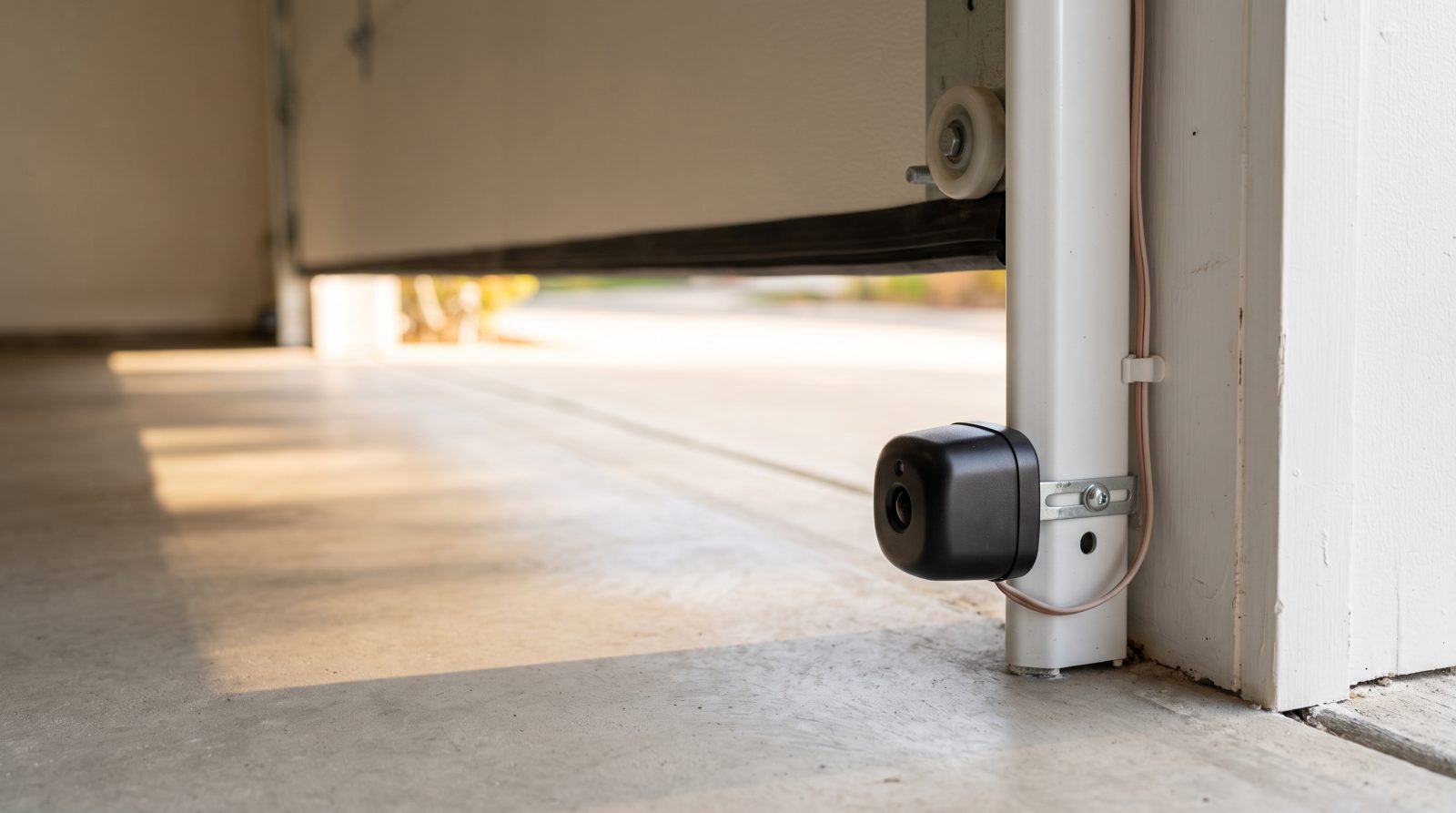
Garage door safety sensors, properly called photoelectric sensors or "photo-eyes," are an invisible safety beam that runs across the bottom of your door opening. One sensor sends an infrared beam, the other receives it. As long as that beam travels cleanly from one side to the other, the opener knows the doorway is clear and will allow the door to close. The instant something breaks the beam, a foot, a pet, a backpack left on the floor, a parked bicycle tire, the opener reverses the door or refuses to start closing at all.
This is not an optional convenience feature. After a series of tragic child injuries, U.S. federal law (UL 325) has required external entrapment protection, almost always photo-eyes, on every residential garage door opener manufactured since January 1, 1993. If your opener is newer than that, it has them, and the door physically cannot be programmed to close without a working beam unless someone holds the wall button down the entire time, which defeats the purpose.
Understanding this changes how you troubleshoot. When a door won't close, most people assume the opener motor is dying or the remote is broken. In reality, the sensors are doing their job and blocking the close because they believe the doorway is not clear. The fix is usually about restoring that beam, not replacing expensive hardware.
- The two sensors mount low on each vertical track, typically four to six inches off the garage floor
- One is the transmitter (sending eye), one is the receiver (the eye that "sees" the beam)
- An unbroken infrared beam tells the opener it is safe to close
- Any interruption of the beam stops or reverses the door
- Federally required on all residential openers built since 1993 under UL 325
Why Sensors Go Out of Alignment (Especially in Sacramento)
Photo-eyes are precise. The beam has to land on the receiving eye almost dead center, and the sensors are held by small, flexible brackets that are surprisingly easy to nudge. The most common cause of a misaligned sensor is simple physical contact: a bumped sensor when you are loading the car, a stored bin sliding into the bracket, a string trimmer or shop vac knocking the housing, or a child's bike falling against the track. A shift of even a few degrees can break the alignment.
Sacramento's environment adds its own twists. Our hot Central Valley summers bake garages well past 100 degrees, and that heat cycle slowly loosens bracket screws and warps cheap plastic mounts over years. Then come the cooler months, when the Delta breeze and Tule fog roll in and leave a film of condensation and dust on the lenses, so the beam reads as "blocked" even though nothing is physically in the way. Garages near the American River, in older neighborhoods like Land Park, East Sacramento, and Curtis Park, often have detached or under-insulated structures that swing through bigger temperature and humidity ranges, which accelerates this drift.
Spiders are another quiet culprit. A web spun directly across a lens, common in less-used garages out in Citrus Heights, Orangevale, or the rural-edge lots toward Elk Grove and Galt, can scatter the infrared beam just enough to trip the safety. Dust from nearby construction, very common across the rapidly growing Natomas and North Natomas corridors, settles on the lenses and dims the signal over time.
- Physical bumps from cars, bikes, bins, and yard tools knocking the brackets
- Valley summer heat loosening screws and warping plastic sensor mounts
- Delta fog and morning condensation fogging the lenses
- Spider webs and dust scattering the infrared beam in low-use garages
- Vibration from a noisy door or opener gradually shaking sensors loose
- Loose or pinched sensor wiring behind the bracket
How to Read the Warning Signs Your Sensors Are Giving You
Your opener is actually trying to tell you what is wrong, you just have to know its language. The clearest tell is the close behavior: if the door closes fine with the remote, the problem is rarely the sensors. But if the door starts to close and immediately reverses back up, or will not move at all when you press the button, the photo-eyes are the first suspect. Many people waste money on remotes and motors before checking the two-dollar fix.
Most openers also use indicator lights on the sensors themselves. Typically one sensor has a steady light showing it has power, and the other has a light that stays solid when the beam is aligned and connected, but blinks, flickers, or goes dark when the beam is broken or misaligned. A steadily lit transmitter paired with a blinking or dark receiver almost always means alignment or a dirty lens. Some opener overhead units also flash their main light a set number of times, often ten blinks, to signal a sensor fault.
Pay attention to the pattern over time, too. A door that closes fine in the cool morning but balks in the hot afternoon points to heat-related drift. A door that fails only on foggy mornings points to condensation on the lenses. A door that suddenly stopped closing right after you reorganized the garage points to a bumped bracket. These patterns are gold for a technician and can shorten a visit considerably.
- Door reverses immediately after starting to close: classic sensor symptom
- Door won't close at all from the remote but the motor hums: check sensors first
- One sensor light steady, the other blinking or dark: alignment or dirty lens
- Opener's overhead light flashing in a repeating pattern: built-in fault code
- Failures that track with time of day or weather: heat or fog drift
What You Can Safely Check Yourself Before Calling
A few sensor problems are genuinely safe for a homeowner to handle, and they are worth trying before anything else. Start by looking at the floor: clear out anything in the doorway, including a thin item like a flattened box or a coiled hose that might be sitting right in the beam's path. Then gently wipe both lenses with a soft, dry cloth or a barely damp microfiber, never a harsh cleaner or paper towel that can scratch the plastic. In Sacramento garages, clearing dust and the occasional spider web off the lenses resolves a surprising number of "dead" doors.
Next, eyeball the alignment. The two sensors should point straight at each other at the same height. If one is visibly tilted or sagging in its bracket, you can often nudge it by hand until the indicator light goes solid. Move slowly and watch the receiver's light; when it stops blinking and stays steady, the beam has reconnected. Also follow the thin wires back from each sensor and look for anything obviously chewed, pinched, or pulled loose, rodents in older Foothill-area and rural-edge garages do occasionally nibble these.
Know where the line is, though. Do not start cutting or splicing wires, removing the opener's cover, or disabling the sensors to force the door shut. Bypassing safety sensors is dangerous and, on a residential door, defeats a federally required protection. If a gentle clean and a careful nudge do not bring back a solid light, the issue is likely a failed sensor, a wiring fault inside the wall or opener, or a deeper opener logic problem, and that is the right time to bring in a mobile technician who comes to you.
- Clear the doorway of anything that could be sitting in the beam
- Gently clean both lenses with a soft, dry or barely damp cloth
- Check that both sensors point at each other at matching heights
- Nudge a tilted sensor by hand until the indicator light goes solid
- Inspect visible wiring for chew marks, pinches, or loose connections
- Never bypass, disable, or force the door past the sensors
When to Call a Mobile Garage Door Pro in the Sacramento Area
Because we are a mobile, we-come-to-you garage door service, getting sensor trouble fixed in the Sacramento area does not mean hauling anything anywhere, a technician brings the parts and tools to your driveway. That matters with sensors, because the right repair often depends on diagnosing on-site: testing both eyes, checking the voltage on the wires, inspecting the brackets, and confirming the opener's logic board is reading the beam correctly. Those are quick checks for a pro and frustrating guesswork for a homeowner.
It is time to call when the indicator light will not go solid no matter how you clean or align the sensors, when a sensor is cracked or water-damaged, when the wiring is damaged inside the wall, or when the door still refuses to close after everything looks correct. It is also worth a professional visit if your opener predates the mid-1990s and may not have proper photo-eyes at all, that is both a safety gap and often a sign the whole opener is near end of life. A technician can confirm whether sensor replacement, rewiring, or a new opener is the smarter spend.
Sensor parts themselves are usually inexpensive, but pricing varies by opener brand and what the real fault turns out to be, so any figures you see online are industry ranges, not quotes. The honest path is a same-day on-site diagnosis where you see the problem confirmed before any work is approved. If your door is stuck open, that is also a security concern worth handling quickly, and a mobile visit gets your home buttoned up the same day. To get started, you can call or request a free quote and a technician will come to you anywhere across the greater Sacramento area.
- Mobile service: a technician comes to your driveway with parts and tools
- Call when the indicator light won't go solid after cleaning and aligning
- Cracked, water-damaged, or unresponsive sensors need replacement
- Damaged in-wall wiring or a faulty opener board requires a pro
- Pre-1990s openers may lack proper photo-eyes, a safety and age red flag
- Same-day on-site diagnosis so you see the fault before approving any work