Common Signs Your Garage Door Opener Needs Repair
Openers rarely fail all at once. They give warnings first, and learning to read them helps you describe the problem and avoid a bigger breakdown. The way an opener misbehaves usually points straight to the failing component, which is why a clear description of the symptom speeds up every mobile visit.
Some symptoms point to electronics, others to the mechanical drive, and a few are actually the safety sensors doing their job correctly. Knowing the difference keeps you from replacing a perfectly good motor when the real issue is a misaligned sensor or a dead remote battery.
- Motor hums or runs but the door does not move (often a stripped drive gear, broken trolley, or disconnected carriage)
- Door reverses before it touches the floor or right after starting down (safety sensor or force/limit setting issue)
- Remote works intermittently or only up close while the wall button works fine (remote, antenna, or receiver fault)
- Opener is unresponsive to everything, no lights, no sound (power, wiring, or logic-board failure)
- Grinding, clicking, or rattling during operation (worn gears, loose hardware, or a chain/belt problem)
- Door opens but will not close, or closes but will not open (limit settings, sensors, or a one-direction motor fault)
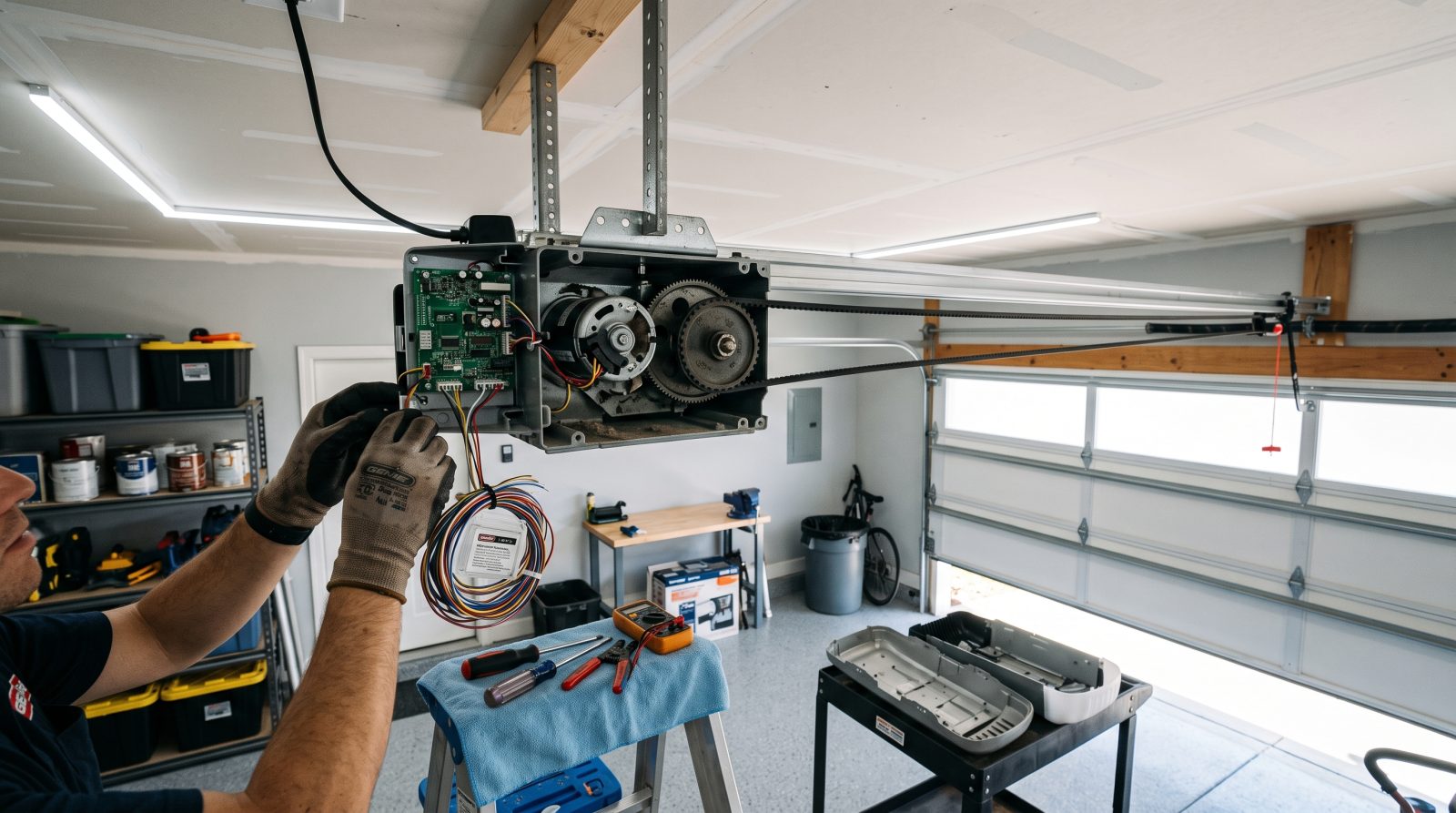
What's Actually Failing Inside the Opener: Motor, Gears, and Logic Board
Most opener problems trace back to one of three systems. Understanding them helps you make an informed decision instead of guessing, and it explains why two doors with the same symptom can need very different repairs.
The drive system is where mechanical wear shows up. Plastic drive gears are a common weak point, especially on chain-drive units that have lifted a heavy door thousands of times. A telltale sign is a motor that spins and hums while the door stays put, the gear teeth have worn down and the motor is no longer engaging the drive. Belts and chains can also stretch, jump off the sprocket, or fray, and the trolley/carriage that connects the rail to the door arm can crack or seize.
The motor itself can wear out from age, heat, or strain, particularly on doors that are out of balance and forcing the opener to do work the springs should be doing. A struggling motor often runs hot, slows down, or trips its internal overload and shuts off mid-cycle. When the motor is failing on an older unit, a full opener replacement is frequently the smarter long-term value than rebuilding around a tired motor.
The logic board is the opener's brain. It controls the relays, learns your remotes, runs the safety logic, and manages the lights. Power surges, a common reality during Sacramento's hot summers and grid strain, can damage these boards, as can age and moisture. Symptoms include random behavior, lights flashing in patterns (which are diagnostic codes), failure to learn new remotes, or a completely dead unit that still has power at the outlet.
- Drive gear / chain / belt / trolley: motor runs but door does not move, or grinding and rattling noises
- Motor: overheating, slowing, mid-cycle shutoffs, burning smell, or no lift power
- Logic board: flashing diagnostic light codes, won't learn remotes, erratic operation, or fully unresponsive with power present
- Capacitor: a hum with no movement on some units points to a failed starting capacitor rather than the gear
Safe DIY Troubleshooting Before You Call
A surprising number of opener calls turn out to be quick fixes you can confirm yourself in a few minutes. Running through these first costs nothing and sometimes saves you a visit entirely. None of these steps require opening the motor housing or touching the high-tension springs, which should always be left to a professional.
Always keep your fingers clear of moving parts and never disable the safety sensors to force a door closed. The photo-eye sensors near the floor exist to stop the door on a child, pet, or car, and they are required on residential openers. If your door won't close because of the sensors, the fix is almost always realignment or cleaning, not bypassing them.
- Check the power: confirm the opener is plugged in and the outlet has power (test it with a phone charger or lamp), and look for a tripped breaker or GFCI
- Replace the remote battery and try the hardwired wall button; if the wall button works but the remote doesn't, it's a remote, not the opener
- Inspect the safety sensors: both should show a steady indicator light; wipe the lenses, clear cobwebs, and gently nudge them back into alignment until the lights stop blinking
- Look for the manual-release cord (the red handle); if the door feels very heavy by hand or slams down, the springs, not the opener, are the real problem, stop and call a pro
- Check the up/down limit and force settings only if you're comfortable, a door that stops short or reverses can sometimes be a simple adjustment
- Listen during a cycle: a hum with no motion, grinding, or clicking tells the technician a lot before they even arrive
How Our Mobile Opener Repair Works in the Sacramento Area
We're a mobile operation, which means we bring the shop to your driveway. There's no dropping anything off and no waiting room. A technician arrives at your home in Sacramento, Elk Grove, Roseville, Folsom, Citrus Heights, Rancho Cordova, Natomas, or the surrounding communities with the common drive gears, belts, trolleys, sensors, remotes, and hardware already on the truck, so most repairs are completed in a single same-day visit.
The visit starts with a real diagnosis, not a parts swap. The technician runs the door, reads any logic-board light codes, checks the drive system and motor, tests the sensors and remotes, and confirms whether the door itself is balanced (an unbalanced door is the hidden cause of a lot of premature opener wear). You get a clear explanation of what failed and why.
From there you get straightforward options. Many openers are worth repairing, a gear kit, a new logic board, a belt, or a sensor pair restores them to full life for a fraction of replacement. But when a motor is burned out on a 15-plus-year-old unit, or parts are discontinued, we'll tell you honestly that replacement is the better value rather than sinking money into a failing machine. Either way, the decision is yours, with no pressure.
- We come to you, stocked for most common opener repairs on the spot
- Honest diagnosis of motor, drive, logic board, and safety systems, plus a door-balance check
- Clear repair-versus-replace guidance based on the unit's age, parts availability, and cost
- Same-day service available across the greater Sacramento area
Repair, Replace, or Upgrade: Making the Right Call
The repair-or-replace question comes down to the opener's age, the failed component, and how much life is left in the rest of the unit. As a general rule, a younger opener with a single failed part, a stripped gear, a blown capacitor, a sensor pair, is almost always worth repairing. An older unit facing a major failure like a dead motor or an obsolete logic board is usually a better candidate for replacement.
There's also a real upgrade case. Older chain-drive units are loud, which matters a lot if a bedroom sits over or beside the garage, a common layout in Sacramento's two-story homes and newer Natomas and Elk Grove builds. Modern belt-drive openers run dramatically quieter, and current models add battery backup (which keeps your door working during the power outages we see during summer heat events and winter storms), smartphone control, rolling-code security, and brighter LED lighting.
As a guide only, parts-and-labor opener repairs commonly fall in a wide industry range from roughly $150 to $400 depending on the failed component, while a new opener supplied and installed typically runs in the broader range of $400 to $700-plus depending on the model and drive type. These are general industry ranges, not a quote, your actual price depends on the specific unit, parts, and what the technician finds on site. We'll give you a clear price before any work begins.
- Repair makes sense: newer unit, single failed part, motor still strong, parts available
- Replace makes sense: dead or failing motor, discontinued board/parts, opener well past its service life, recurring failures
- Upgrade worth considering: noisy chain drive near living space, no battery backup, no modern security or smart features
- Costs above are labeled industry ranges for guidance only and are not a quote; you get a firm price on site before work starts