Start With the Door, Not the Opener
The most common mistake homeowners make is shopping for an opener before understanding the door it has to lift. An opener does not lift the full dead weight of your garage door, that job belongs to the springs above the opening. The opener's real job is to gently move a counterbalanced door the last bit and hold it in position. This is why a door with worn, weak, or mismatched springs will burn out even the most powerful opener prematurely. Before you spend a dollar on a motor, the springs, rollers, and tracks need to be in good shape.
Door size and material drive everything that follows. A single-car aluminum or thin-steel door is light. A double-wide door, an insulated multi-layer steel door, or a solid wood carriage-house door, common on the older custom homes in East Sacramento and the Fab 40s, can weigh two to three times as much. Heavier doors call for more pulling power and a more robust drive. Insulation matters in our climate too: an insulated door on an attached garage keeps the adjoining rooms far more livable in a Sacramento summer, and a heavier insulated door changes the opener math.
When we arrive on a service call, the first thing we do is balance-test the door by hand with the opener disconnected. If a properly balanced door floats halfway up and stays put, the springs are doing their job and almost any correctly sized opener will last for years. If the door slams down or shoots up, no opener will fix that, it is a spring and balance issue first. Getting this order right is the difference between an opener that lasts a decade and one that fails in two summers.
- Single-layer steel or aluminum door: lightest, easiest on any opener
- Insulated multi-layer steel: heavier but far better for attached Sacramento garages in summer heat
- Solid wood or carriage-house: heaviest, common on older East Sac and Land Park homes, needs the most capable drive
- Always confirm spring health and door balance before judging opener power
The Four Drive Types Explained
Every garage door opener uses one of four drive mechanisms to move the door, and the one you pick shapes how loud it is, how much maintenance it needs, and how long it lasts. There is no single best answer, the right choice depends on your door, your garage layout, and how much noise you can tolerate, especially in an attached garage with a bedroom directly above or beside it.
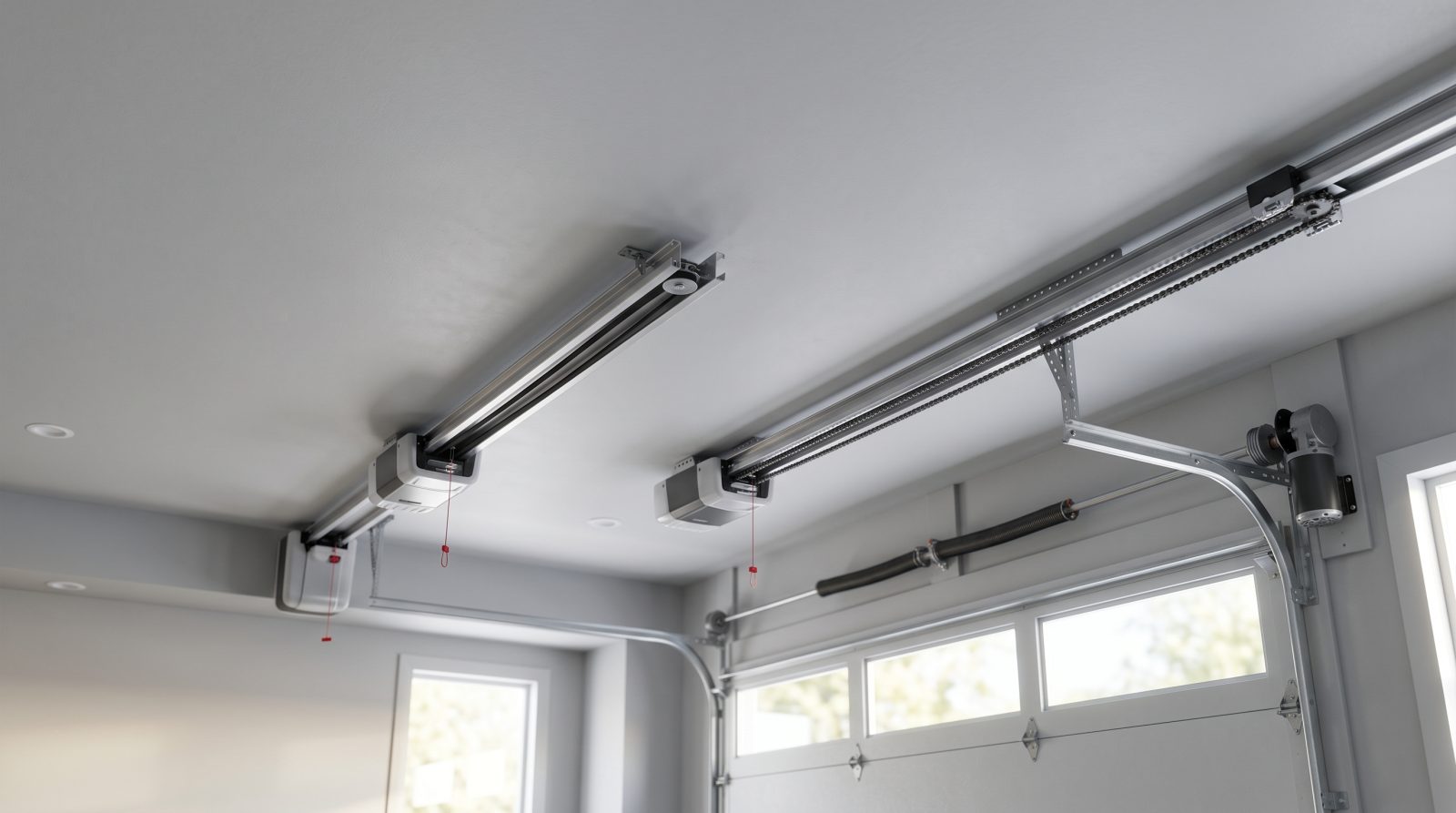
Chain-drive openers use a metal chain, like a bicycle chain, to pull the door along the rail. They are the workhorse standard: durable, affordable, and powerful enough for almost any residential door. The trade-off is noise and vibration. In a detached garage, or one with no living space nearby, a chain drive is a perfectly sensible, long-lasting choice. In an attached garage under a bedroom, the rattle can be intrusive.
Belt-drive openers swap the chain for a reinforced rubber or steel-reinforced polymer belt. They are dramatically quieter and smoother, which is why they have become the most-requested upgrade for the many Sacramento homes where the garage shares a wall or floor with bedrooms and living rooms. They typically cost a bit more than a comparable chain drive, but for attached-garage homeowners the quiet is usually worth it.
Screw-drive openers move the trolley along a threaded steel rod. They have fewer moving parts and were historically valued for reliability with fewer components to maintain. Their weak spot is temperature sensitivity, the lubricant on the rod can thicken in cold and thin in extreme heat, which matters in a region that swings from foggy Delta mornings to triple-digit afternoons. Modern self-lubricating versions handle this better than older units.
Jackshaft (wall-mount) openers are the newest residential category. Instead of a rail running across the ceiling, the motor mounts on the wall beside the door and turns the torsion bar directly. They free up the entire ceiling, ideal for garages with high ceilings, overhead storage racks, or a car lift, and they are very quiet. They cost more and require a door with a torsion-bar setup in good condition, but for the right garage they are an elegant solution.
- Chain drive: most affordable and rugged; louder, best for detached garages
- Belt drive: quietest and smoothest; the go-to for attached garages near bedrooms
- Screw drive: fewer parts; choose a self-lubricating model given our heat swings
- Jackshaft / wall-mount: frees the ceiling, very quiet; needs a healthy torsion-bar door, higher cost
How Much Horsepower (and Torque) You Actually Need
Horsepower ratings, commonly seen as half, three-quarter, and one-plus horsepower equivalents, are the headline number on the box, but they are easy to misread. More horsepower does not mean your door opens faster or that you should always buy the biggest motor. What you are really matching is the opener's pulling capacity to the weight and size of your door, with some margin so the motor is not constantly working at its limit.
For a standard single-car door, especially a lighter steel or aluminum one, a smaller motor is usually plenty. For a standard double-wide door, the most common configuration in Sacramento's tract neighborhoods like Natomas, Antelope, and Elk Grove, a mid-range motor gives comfortable, reliable performance. For heavy insulated doubles or solid-wood carriage doors, stepping up to a higher-capacity DC motor protects the unit from overwork and extends its life.
Pay attention to motor type as much as the horsepower figure. Modern DC (direct-current) motors run quieter, start and stop more smoothly with soft-start and soft-stop, and many include battery backup so the door still opens during one of the planned outages or storm-related interruptions we occasionally see in the region. AC motors are simpler and often cheaper but louder and without those refinements. For most homeowners upgrading today, a DC motor is the more comfortable, future-proof pick.
The honest takeaway: buy enough capacity for your door with a sensible cushion, then spend your remaining budget on motor quality and features rather than chasing the highest horsepower number. An oversized motor on a light door is wasted money; an undersized motor on a heavy door is a service call waiting to happen.
- Match opener capacity to door weight and size, with a margin, not to the biggest number
- Single-car light door: a smaller motor is typically sufficient
- Double-wide door (common in Sacramento tracts): a mid-range motor is the comfortable choice
- Heavy insulated or solid-wood door: step up to a higher-capacity DC motor
- Favor a DC motor for quieter operation, soft start/stop, and available battery backup
Smart Features Worth Paying For (and Ones to Skip)
Today's openers come loaded with technology, and some of it is genuinely useful while some is marketing. The features worth prioritizing are the ones that improve safety, security, and everyday convenience without becoming a maintenance burden. Start with the non-negotiable safety items required on modern openers: photo-eye sensors that stop and reverse the door if anything crosses the opening, and automatic reverse on contact. If your current opener predates these, that alone is a strong reason to upgrade, particularly in a busy household with kids or pets.
Wi-Fi connectivity and smartphone control are the standout convenience upgrade. Being able to check whether the door is closed from your phone, and shut it remotely, solves the universal 'did I leave the garage open?' anxiety, which matters because an open garage is the most common easy-access point for home break-ins. Pair this with smart alerts that notify you if the door opens unexpectedly or has been left open too long, useful for anyone juggling school runs and work across the Sacramento commute.
Battery backup deserves a second mention because it is more than a luxury here. When power goes out, a backup-equipped opener still lets you get the car out without hauling on the manual release in the dark. For many Californians this is also a code consideration on newer installations. Other worthwhile extras include integrated LED lighting that brightens the whole garage, a strong, well-supported remote and keypad system, and rolling-code security that prevents code-grabbing.
What can you skip? Be skeptical of proprietary ecosystems that lock you into one brand's accessories at premium prices, gimmicky add-ons you will never set up, and the very cheapest big-box units whose plastic gears and short warranties tend to mean a repeat purchase sooner than you would like. A mid-tier opener from a reputable manufacturer with a solid warranty almost always delivers better long-term value than either the bargain unit or the maxed-out flagship.
- Must-have: photo-eye sensors and automatic reverse, the core safety system on any modern opener
- High value: Wi-Fi control and open/left-open alerts to close a forgotten door from your phone
- Worth it here: battery backup so the door works during a power outage
- Nice extras: bright LED lighting, rolling-code security, reliable remotes and keypad
- Skip: gimmicky add-ons and rock-bottom big-box units with plastic gears and thin warranties
Sacramento-Specific Considerations: Heat, Dust, and Attached Garages
An opener that performs beautifully in a mild coastal climate can struggle in the Sacramento Valley, so it pays to choose with our conditions in mind. Summer is the big one. Attached garages here regularly bake well past 110 degrees inside during a July heat wave in places like Roseville, Rocklin, and Folsom. That heat is hard on electronics, on lubricants, and on rubber components. It is a strong argument for a quality DC unit with good thermal handling, for a belt or self-lubricating drive over an older screw drive whose lubricant thins in extreme heat, and for keeping the opener and door serviced before the worst of summer hits.
Dust and fine valley grit are the quieter enemy. Our long dry season coats everything, and that grit works its way into rollers, hinges, and the rail. An opener forced to drag a door on dry, dust-clogged rollers works harder and wears faster. Periodic cleaning and proper lubrication of the door hardware, not just the opener, keeps the whole system smooth and protects the motor you just invested in. This is routine maintenance we handle on a standard visit.
The attached-garage layout that dominates Sacramento neighborhoods makes noise and insulation real decisions, not afterthoughts. If your garage sits under or beside a bedroom, a belt-drive or wall-mount opener will noticeably improve life inside the house. Pairing a quiet opener with an insulated door also helps keep the adjoining rooms cooler in summer and reduces the temperature load the opener's electronics endure. These choices compound: a quieter, cooler garage is easier on both your comfort and your equipment.
Because we are a mobile garage door company, we bring all of this to your driveway. We can assess your existing door's weight, balance, and hardware on site, factor in your garage's orientation and whether it bakes in afternoon sun, and recommend an opener and drive type that fits your home rather than a generic best-seller. If you are weighing a replacement, you can call or request a free quote and we will come to you anywhere across the greater Sacramento area.
- Choose for heat: a quality DC motor and a belt or self-lubricating drive handle our extreme summers better
- Manage dust: keep rollers, hinges, and the rail clean and lubricated so the motor is not overworked
- Attached garage near bedrooms: prioritize a belt-drive or wall-mount opener for quiet
- Pair a quiet opener with an insulated door to cool adjoining rooms and ease the load on the electronics
- We assess your actual door on site across the Sacramento area, mobile, we come to you