The Big Picture: A Counterbalanced System, Not a Motor That Lifts the Door
The single most common misconception about garage doors is that the opener lifts the door. It does not. A typical sectional door weighs anywhere from roughly 130 to over 350 pounds depending on size, material and insulation, and the small motor on your ceiling could never hoist that much weight reliably for years on end. What actually does the heavy lifting is the spring system, which stores mechanical energy and counterbalances the weight of the door so that the door is nearly weightless when properly adjusted. The opener simply nudges that balanced load up and down and holds it in place.
This counterbalance principle is the key to understanding everything else. When a door is balanced correctly, you should be able to lift it by hand and have it stay roughly in place at waist height. When springs weaken or break, that balance is lost, the opener is suddenly asked to drag the full dead weight of the door, and the whole system begins to struggle, strain and fail. Almost every dramatic garage door failure traces back, directly or indirectly, to this balance being thrown off.
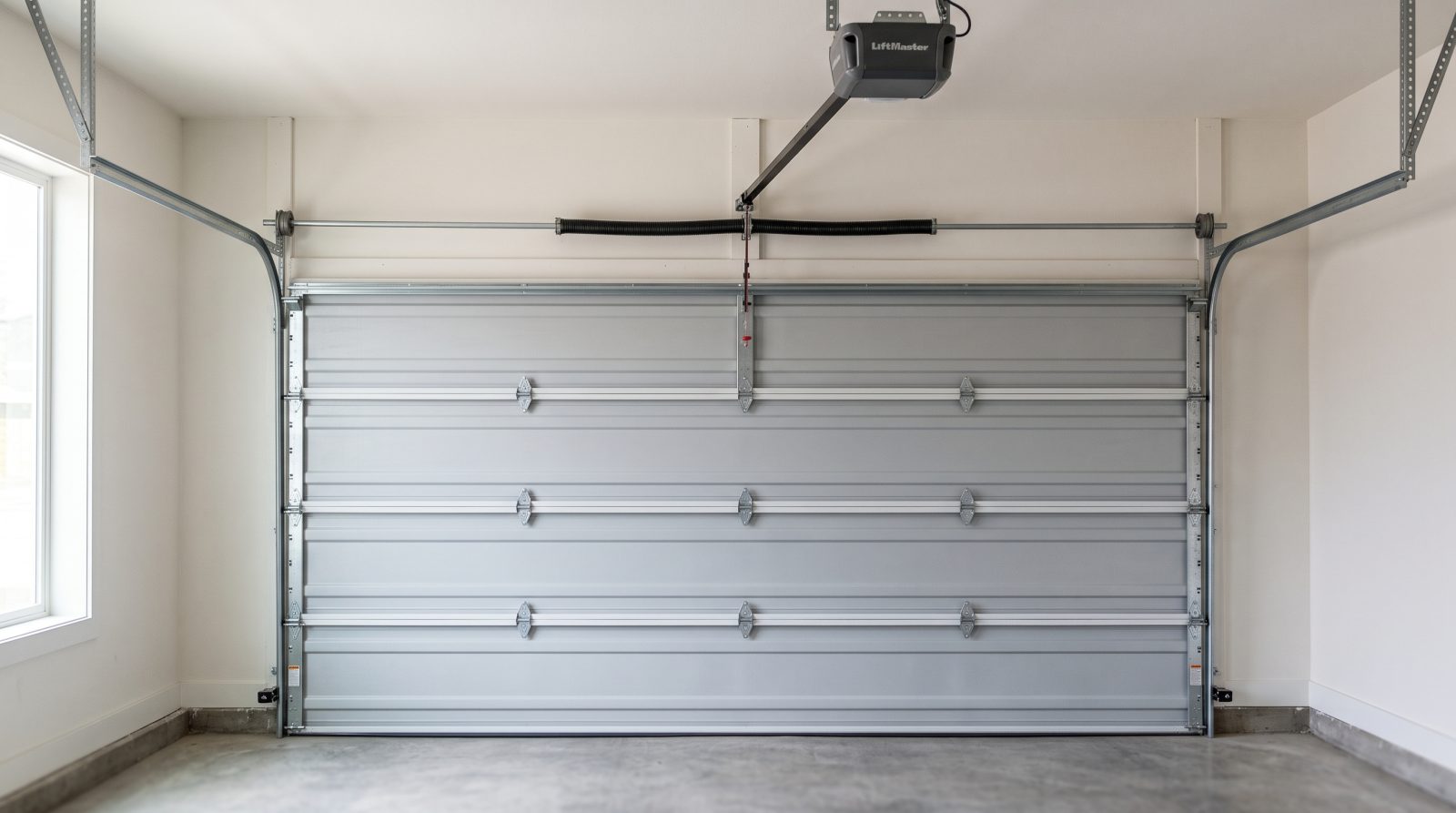
The door itself is built from horizontal sections (panels) hinged together so the assembly can bend around a curved track and travel from vertical to horizontal overhead. Rollers ride inside that track, cables tie the bottom of the door to the spring system, and the opener connects at the top center. Every part is there to serve the balanced, hinged, roller-guided movement of those panels.
Springs: The Heart of the System
Springs are where the real work happens, and they are also the part most likely to bring the whole system down when they fail. There are two main types. Torsion springs mount on a metal shaft above the door opening and store energy by twisting; as the door closes, cables wind the shaft and load the spring, and as the door opens, the spring unwinds and delivers that stored force to raise the door. Extension springs run along the horizontal tracks on either side and stretch and contract to do the same job. Torsion systems are generally more durable, balanced and common on modern doors, while extension springs are often found on older or lighter installations.
Springs are rated in cycles, with one cycle being a single open-and-close. A standard spring is often rated for somewhere in the range of 10,000 cycles, which sounds like a lot until you realize a busy household that uses the garage as its main entrance can burn through 1,500 to 2,000 cycles a year. That puts many springs on a realistic lifespan of roughly seven to twelve years of normal use, sooner with heavy use and faster in a climate like ours where summer heat and winter damp accelerate metal fatigue and surface rust. When a spring lets go it usually does so with a loud bang, and afterward the door feels impossibly heavy or refuses to open at all.
This is the one component we have to be blunt about: a wound torsion spring or a stretched extension spring holds an enormous amount of stored energy, and attempting to adjust or replace one without the proper winding bars and training is genuinely dangerous. This is not a frugal weekend project. If you suspect a broken or weak spring, stop using the door and call for a trained tech rather than risk serious injury.
Cables, Drums, Rollers and Tracks: The Moving Hardware
If springs are the engine, the cables and drums are the transmission that delivers the power. On a torsion system, a steel lift cable runs from the bottom bracket on each side of the door up to a grooved drum mounted on the spring shaft. As the spring unwinds, the drums wind up the cable and pull the door upward in a controlled, even way. The two sides must stay in sync; when one cable frays, slips off its drum or snaps, the door immediately goes crooked, can jam in the track, and puts dangerous strain on the remaining hardware.
Rollers are the wheels that let the door glide. Each panel carries rollers on both sides that ride inside the vertical and horizontal tracks, guiding the door around the bend from upright to overhead. Cheaper plastic or worn steel rollers grind, squeal and eventually seize, which is a frequent source of that nails-on-a-chalkboard noise homeowners describe. Nylon rollers with sealed bearings run far quieter and last longer. The tracks themselves must stay straight, plumb and firmly anchored; a track that has been bumped by a car bumper, worked loose, or bent will cause the door to bind, hop or stick.
Hinges tie the panels together and take a surprising amount of stress at the points where the door flexes. In Sacramento's climate, the daily swing from dry heat to overnight moisture, plus airborne dust and the fine grit that blows in from the Valley, tends to dry out factory lubricant and invite surface corrosion on cables, rollers, springs and hinges. That is why so many local service calls start as a simple noise or hesitation that, left alone, grows into a stuck or damaged door.
The Opener and Its Safety Systems
The opener is the automation layer that sits on top of the mechanical door. A motor in the ceiling unit drives a trolley along a rail using one of a few drive types: a chain drive (durable and economical but noisier), a belt drive (quieter, popular for garages under living space), or a screw drive. The trolley pulls or pushes the door through an arm connected to the top panel, while a logic board interprets your wall button, remotes and any smart-home signals. Modern openers also store travel limits in memory so they know exactly how far to move the door and how much force is normal, and they will reverse or stop if something is off.
By federal law, every residential opener built since the early 1990s must include external entrapment protection, which on virtually all systems means photo-eye safety sensors. These are the two small units mounted a few inches above the floor on each side of the door. They shoot an invisible infrared beam across the opening, and if anything breaks that beam while the door is closing, the door must reverse. Misaligned, dirty, sun-blinded or disconnected sensors are one of the most common reasons a door refuses to close or reverses for no apparent reason, and in our long bright Sacramento afternoons, low-angle sunlight hitting a sensor lens is a genuinely frequent culprit.
Openers also rely on a force-and-travel calibration to detect obstructions through resistance. If the door becomes unbalanced because a spring is weakening, the opener senses the unexpected load and may reverse or stop partway, which homeowners often misread as an opener problem when the real fault is mechanical. This is exactly why a good diagnosis tests the door manually and the opener separately rather than just blaming the motor.
How a Single Open-and-Close Cycle Actually Happens
It helps to walk through one full cycle in order, because that sequence is what a technician mentally retraces when something goes wrong. You press the remote or wall button, and the opener's logic board wakes the motor. The trolley moves along the rail and, through the arm on the top panel, begins to move the door. At the same moment the spring system releases its stored energy, the drums feed out cable, and the door's own counterbalance does most of the lifting while the opener guides the motion and keeps both sides even.
As the panels travel, the rollers carry each section around the curve in the track, the door folds from vertical to horizontal, and the panels come to rest overhead. The opener stops at its programmed open limit. To close, the process reverses: the trolley pulls the door down, the cables wind back onto the drums, the spring re-loads with stored energy, and the photo-eyes stand guard across the opening the entire way down. If the beam is clear and the force feels normal, the door seats against the floor and the opener stops at its closed limit.
Because every stage depends on the one before it, a fault in any single part shows up as a recognizable symptom. A broken spring means the opener strains or quits. A frayed cable means the door goes crooked. A worn roller or bent track means binding and noise. A blocked photo-eye means the door reverses or will not close. Learning to read these symptoms is what lets you describe the problem accurately and avoid replacing the wrong part.
What Wears Out First in Sacramento, and What You Can Safely Do
Our regional climate shapes how these systems age. The Central Valley's intense, prolonged summer heat bakes lubricant out of moving parts and stresses opener electronics in an un-air-conditioned garage, while winter fog and Delta moisture promote surface rust on springs, cables and rollers. Fine dust and grit work their way into bearings and tracks year-round. The practical result is that local doors tend to get noisy and sticky before they fully fail, which is good news, because noise and hesitation are early warnings you can act on.
There are a handful of things a homeowner can safely do. You can keep the photo-eye lenses wiped clean and confirm both indicator lights are steady. You can do a balance test: with the door closed, pull the opener's red emergency-release cord to disconnect it, then lift the door by hand. A balanced door moves smoothly and stays put around halfway; a door that slams down or shoots up, or feels extremely heavy, is telling you the springs are out of adjustment and need professional attention. You can also visually inspect cables and springs for fraying, gaps or rust without touching them, and listen for new grinding or popping sounds.
What you should not do is adjust, wind or replace springs, swap cables, or bend tracks, because those carry the system's stored energy and structural load. Because we are a mobile garage door service, we come to you anywhere in the Sacramento area and diagnose the whole system on site rather than guessing over the phone, which matters when symptoms overlap. If your door is noisy, crooked, heavy, slow, or stuck, the safest move is to stop cycling it and request a free quote so a trained tech can pinpoint the real cause before a small fix becomes a bigger one.