The Quick Answer: Typical Lifespans by Component
There is no single number for how long a garage door lasts, because the system is made of parts that wear at very different rates. The structural door usually outlives everything bolted to it, the opener is an electronic appliance with a predictable middle-age decline, and the springs are consumable parts engineered to a finite number of cycles. Thinking in components, rather than treating the door as one object, is the key to budgeting and avoiding surprise failures.
These are widely accepted industry lifespan ranges for residential systems under normal use. Sacramento's climate tends to push real-world results toward the lower end of each range, which we cover in detail below. Treat these as planning guides, not guarantees: a door that opens six times a day ages far faster than one used twice a week.
- Garage door (panels/sections): roughly 15-30 years, longer for steel and well-maintained doors, shorter for thin or neglected ones
- Garage door opener: roughly 10-15 years before motor, gears, or circuit boards start failing
- Torsion springs: roughly 7-12 years at a standard 10,000-cycle rating, often 4-7 years with heavy daily use
- Extension springs: similar cycle life but more exposed, often showing wear sooner
- Rollers (nylon vs. steel): roughly 5-15 years depending on material and lubrication
- Cables, hinges, and weatherstripping: typically the first wear items, often serviced or replaced well before the door itself
Garage Door Panels: Why the Door Outlasts Everything Else
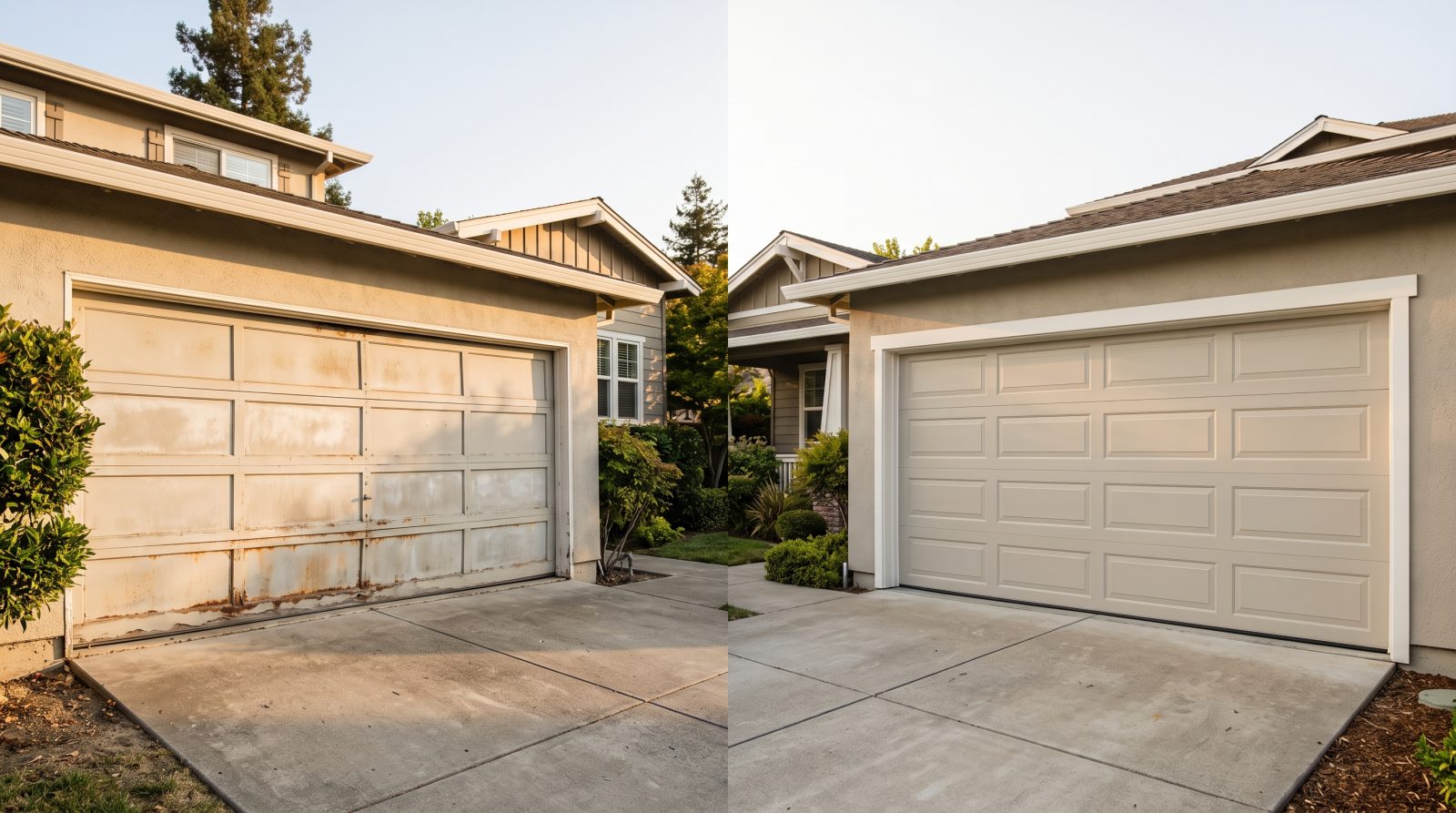
The door itself is the long-haul component. A quality steel, aluminum, or composite door can serve a Sacramento home for 20 to 30 years or more, because the panels do not have a motor to burn out or a spring to fatigue. What ages the door is the surface and the structure: finish breakdown from UV exposure, dents from cars and basketballs, rust at the bottom seam where water collects, and sagging or delaminating panels on cheaper builds.
Material matters enormously here. Insulated steel doors hold up well to the Valley heat and resist warping. Solid wood doors look beautiful but demand the most upkeep in our dry-then-damp seasonal swings, as they expand, contract, and need refinishing to avoid cracking. Aluminum and glass doors resist rust but dent more easily. The good news is that a tired-looking door is often structurally fine, and many problems people blame on 'the door' are actually worn hardware, a failed spring, or a misaligned track, all of which are far cheaper to fix than a full replacement.
Because Sacramento sun is relentless on west- and south-facing garages, the finish is usually the first thing to go. Faded paint and chalky surfaces are cosmetic, not structural, and repainting or resealing can buy many more years of service before replacement is genuinely warranted.
- Steel and composite doors generally last longest with the least maintenance in our climate
- Wood doors last well but need periodic refinishing to survive the heat-and-humidity swings
- Rust at the bottom edge is a real lifespan-ender; keep that seam sealed and drainage clear
- Many 'the door is dying' complaints trace back to hardware or springs, not the panels themselves
Openers and Springs: The Parts That Actually Wear Out First
If something on your system fails, it is almost always the opener or the springs, not the door. The opener is essentially a small appliance: a motor, a gear assembly (often a plastic drive gear in chain and screw-drive units), a logic board, and sensors. Most last 10 to 15 years. The first signs of an aging opener are intermittent operation, grinding or straining noises, slow or jerky travel, and increasingly flaky remotes or wall buttons. Many failures are repairable, a stripped drive gear, a worn capacitor, or faulty safety sensors, so a struggling opener does not automatically mean a new unit.
Springs are the hardest-working and most safety-critical part of the entire system, and they are designed to wear out. Torsion springs are rated by cycles, with a common builder-grade rating around 10,000 cycles. One cycle is one open and one close. A family that opens the door four times a day burns roughly 1,460 cycles a year, which works out to about seven years before a 10,000-cycle spring is at the end of its rated life. Use the door more, run multiple drivers, or have it as your main entrance, and that timeline shrinks fast. Higher-cycle springs (15,000 to 30,000+) cost a bit more up front but can double or triple service life.
Spring failure is the single most common reason a garage door suddenly stops working, and it is also the most dangerous part to touch. Springs are under extreme tension, and a broken or improperly handled spring can cause serious injury. This is firmly a job for a trained technician with the right tools, never a DIY weekend project. Because we are mobile, we can replace springs and service openers right in your driveway across the Sacramento area.
- Openers: 10-15 years; watch for grinding, slow travel, reversing, and dying remotes
- Springs are rated in cycles (open + close = one cycle); 10,000 cycles is common builder-grade
- Heavy daily use can cut spring life to 4-7 years; high-cycle springs extend it significantly
- A broken spring is the top cause of a door that won't open and is dangerous to handle yourself
- Both openers and springs are frequently repairable, so failure rarely means replacing the whole system
How Sacramento's Climate Shortens Garage Door Lifespan
National lifespan averages assume mild, stable conditions. Sacramento is not mild. Our long, intensely hot summers, big day-to-night temperature swings, fine Central Valley dust, and hard water all conspire to age garage door systems faster than the textbook numbers suggest. Understanding these local stressors is the difference between replacing parts on your schedule and replacing them in an emergency.
Heat is the headline issue. Triple-digit summer days bake the door finish, soften lubricants, and stress opener electronics that sit in an attached garage with little ventilation, where temperatures can climb well past the outdoor reading. UV exposure fades and chalks paint on sun-facing doors, and the constant expansion and contraction loosens fasteners and accelerates metal fatigue in springs and cables.
Then there is dust and hard water. The Valley's fine dust settles into rollers, hinges, and tracks, where it mixes with old grease to form a grinding paste that wears moving parts and makes the opener work harder. Hard-water mineral content, common across much of the Sacramento region, can leave deposits that contribute to corrosion over time, especially on the lower hardware near where water and sprinkler overspray collect. The single most effective defense is simple, regular maintenance, the right lubricant, clean tracks, balanced springs, and tight hardware, which directly extends how long every component lasts.
- Intense summer heat bakes finishes, thins lubricant, and stresses opener electronics in hot attached garages
- UV on west- and south-facing doors fades and chalks paint years ahead of shaded doors
- Big daily temperature swings loosen fasteners and speed up metal fatigue in springs and cables
- Central Valley dust turns old grease into a grinding paste inside rollers and tracks
- Hard-water minerals and sprinkler overspray encourage corrosion on lower hardware over time
- Routine maintenance is the highest-payoff way to claw back lost lifespan in this climate
Warning Signs and How to Maximize Your Door's Lifespan
Garage doors rarely fail without warning. Catching the early signals lets you handle a small repair on your terms instead of an emergency when the door is stuck. Pay attention to how the door sounds, moves, and balances. Grinding, popping, or scraping noises, jerky or uneven travel, slow response, a door that sags or looks crooked when closing, gaps in the weatherstripping, and any visible gap or kink in a spring are all telling you the system needs attention.
A simple balance test reveals a lot. With the door closed, pull the opener's manual release cord and lift the door by hand to about waist height, then let go. A properly balanced door should hold roughly in place. If it slams down or shoots up, the springs are out of tune and are forcing the opener to overwork, which shortens the opener's life too. (If the door is heavy or fights you, stop, this points to a spring problem that needs a technician.) Run this test only with the opener disengaged and never put hands near spring components.
The biggest lever on lifespan is maintenance, and most of it is straightforward. A few habits, done consistently, can add years to every component and keep the whole system quiet, safe, and reliable through Sacramento summers. When a part is genuinely at end of life, a targeted repair, such as new springs, fresh rollers, or an opener gear, is usually far more cost-effective than a full door replacement, and we can give you an honest repair-versus-replace assessment on site.
- Warning signs: grinding or popping noises, jerky travel, slow response, sagging, or a visible gap in a spring
- Lubricate springs, rollers, hinges, and bearings a couple of times a year with a proper garage-door lubricant (not WD-40)
- Keep tracks clear of Valley dust and debris, and tighten loose hardware as heat-cycling works it loose
- Test the door's balance periodically and the safety reverse on the opener for safety
- Address small issues early; a worn roller or loose hinge is cheap, a neglected one damages neighboring parts
- When something fails, repair is often smarter than replacement, ask for a repair-vs-replace assessment