What a Roll-Up (Coiling) Door Is, and Why Sacramento Uses So Many of Them
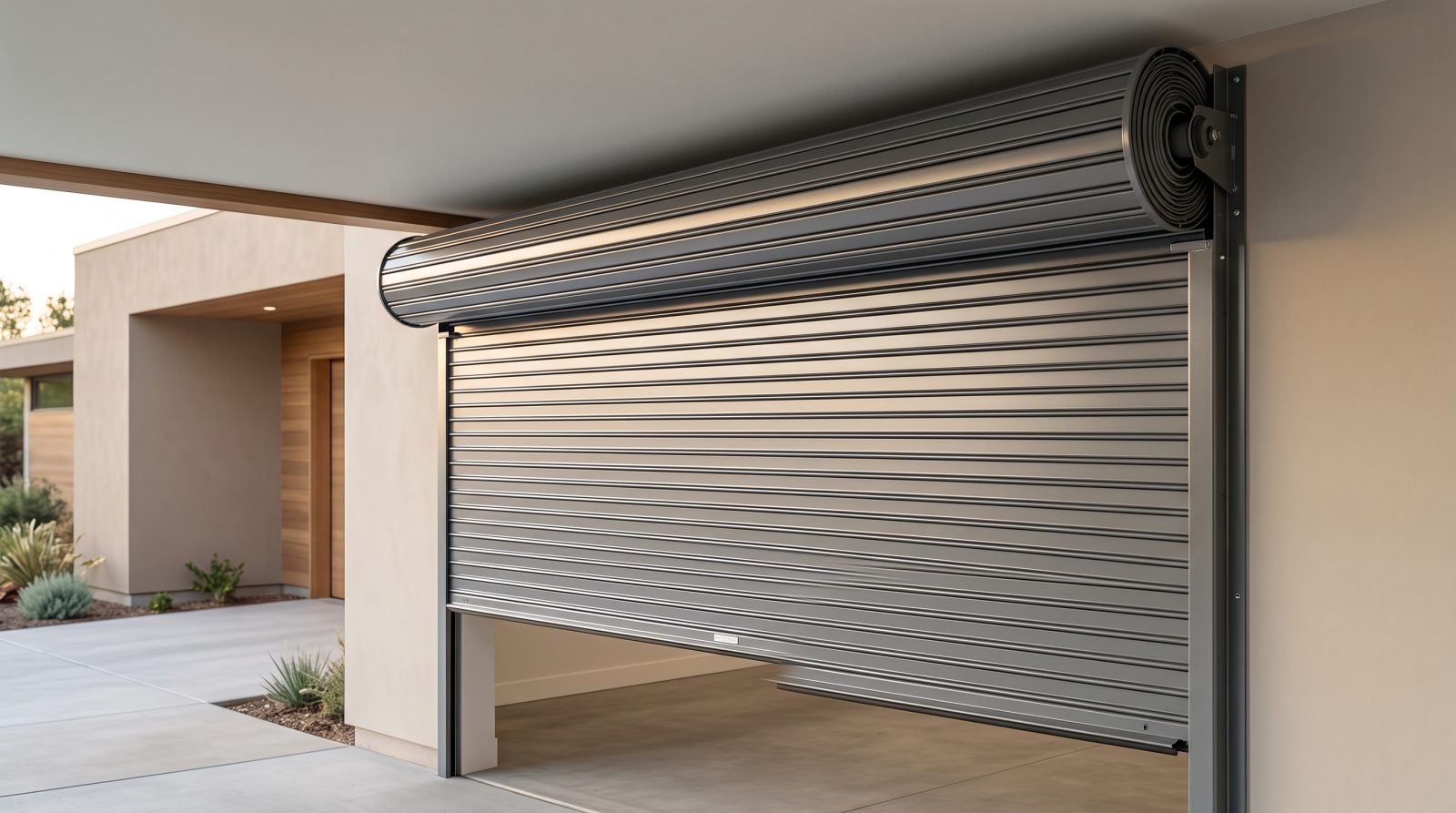
A roll-up door, also called a coiling door, is built from many narrow horizontal slats hinged together, or in lighter residential versions from a single continuous curtain. Instead of folding back on horizontal tracks like a sectional door, the curtain rolls up around a barrel and counterbalance assembly mounted directly above the opening. That design is the whole reason these doors are everywhere in the Sacramento area: they need almost no ceiling clearance, they tolerate constant use, and the heavier steel versions resist dents and forced entry far better than a typical residential panel.
In our service area you will find two very different populations of these doors, and they fail in different ways. The first is commercial: storefront security grilles in Downtown and Midtown, self-storage units along Folsom Boulevard and out toward Rancho Cordova, warehouse and shop doors in the industrial pockets near Power Inn and West Sacramento, and fire-rated coiling doors inside commercial buildings. The second is residential: compact homes, alley garages, detached studios, and converted spaces in neighborhoods like Land Park, Curtis Park, and East Sacramento where headroom is limited or the owner wants to keep the ceiling open for storage.
Knowing which type you have changes the repair entirely. A commercial steel coiling door carries far more spring tension and weight than a residential roll-up, and the counterbalance, barrel, and guides are engineered for thousands of cycles. We size every repair to the actual door in front of us rather than treating a 14-foot warehouse door and a 7-foot home garage the same way.
The Roll-Up Door Problems We See Most in the Sacramento Area
Roll-up doors fail in predictable patterns, and Sacramento's environment pushes a few of them harder. Our hot, dry summers bake out the original lubrication and let dust and grit build up in the guides, while the damp stretches of winter and the fine ag and road dust common across the valley accelerate corrosion on hardware. The result is a door that gets progressively harder to lift, then suddenly stops.
On commercial and steel coiling doors, the most common calls are about the door binding or jamming halfway, slats that are bent or pulled out of the guides after a forklift or vehicle strike, a broken counterbalance spring inside the barrel, worn or seized bottom-bar and guide rollers, and chain hoists or operators that no longer move the door smoothly. On lighter residential roll-up doors, we more often see a stiff or noisy curtain, a door that crawls or stalls, a snapped spring, and openers that strain because the door itself has gone out of balance.
Two issues deserve special attention because they are safety-critical. A broken or weakened counterbalance spring means the door's weight is no longer supported, and a heavy steel curtain that drops is dangerous. And a door that has been hit and knocked out of its guides should not be forced up or down, because running it can damage the barrel and bend more slats. In both cases the right move is to stop using the door and have it looked at.
- Door binds, jams, or stops partway up the opening
- Bent, cracked, or dislodged slats after a vehicle or forklift strike
- Broken counterbalance spring inside the barrel (door feels extremely heavy or won't hold position)
- Worn guides, rollers, or bottom bar causing grinding and drag
- Curtain off its guides or hanging crooked
- Chain hoist, manual crank, or motor operator that slips or won't move the door
- Heat-baked or grit-clogged tracks that need cleaning and re-lubrication
How We Diagnose and Repair Roll-Up Doors On Site
Because we are mobile, the diagnosis happens where the door lives, not over the phone with guesswork. When we arrive we first secure the door so nothing can drop, then run it through its travel by hand or with the operator to find exactly where the resistance, noise, or stall starts. From there we inspect the counterbalance and barrel, the guides and brackets, the slats or curtain, the bottom bar, and the operator or hoist as one connected system, because a problem in one almost always shows up as a symptom somewhere else.
Most repairs we complete in a single visit. That includes replacing a broken counterbalance spring and re-tensioning the door, straightening or replacing damaged slats, re-seating a curtain that has come out of its guides, swapping worn rollers and bottom-bar hardware, cleaning and re-lubricating gritty guides, and adjusting or repairing chain hoists and operators. We carry common hardware so a typical residential roll-up or a standard commercial coiling door can often be fixed the same day; less common commercial parts and full curtain sections may need to be ordered, and we will tell you that up front rather than improvising a fix that won't last.
Every repair ends with the same step that prevents the next emergency: we re-balance the door so the counterbalance, not the operator, is carrying the weight, and we cycle it several times to confirm smooth, even travel. A properly balanced roll-up door is quieter, lasts longer, and stops burning out openers and hoists.
Repair or Replace? A Straight Answer for Homes and Businesses
Most roll-up doors are worth repairing, and a single failed spring, a few bent slats, or worn guides almost never justifies a full replacement. We lead with the repair whenever the door's structure is sound, because it is faster, less expensive, and keeps a storefront or a household running with the least disruption.
Replacement starts to make sense when the curtain itself is the problem: widespread corrosion eating through the slats, repeated impact damage that has deformed multiple sections, a barrel or guide system that is bent beyond true, or a fire-rated door that no longer meets its rating after damage. For a business, there is also a downtime calculation, if a critical dock or security door is failing often enough to threaten daily operations, a planned replacement can cost less than a string of emergency repairs.
When replacement is genuinely the better call, we help you match the door to the opening and the use: heavier insulated steel coiling doors for warehouses and shops, open-grille coiling doors for storefront security, and lighter, space-saving roll-up doors for compact Sacramento garages where headroom is the constraint. We give you the trade-offs in plain language and an honest, itemized recommendation so you can decide. Costs for roll-up and coiling work vary widely with door size, gauge, and type, so any figure we discuss is an industry range for planning, not a quote, your actual price comes after we see the door.
- Repair usually wins: broken springs, a few bent slats, worn rollers/guides, off-track curtains
- Lean toward replacement: rusted-through slats, repeat impact damage, a bent barrel, or a compromised fire-rated door
- For businesses, weigh recurring downtime against a planned replacement
- We match new doors to the opening: insulated steel, security grille, or compact residential roll-up
Mobile Service Across Greater Sacramento
We come to you anywhere in the Sacramento area, from Downtown, Midtown, and East Sacramento to Natomas, Elk Grove, Folsom, Rancho Cordova, Citrus Heights, Carmichael, and across the river into West Sacramento. For commercial clients, that means we can service a roll-up door at a storage facility, a strip-mall storefront, or an industrial unit without you having to shut down and haul anything anywhere. For homeowners with compact garages, it means the fix happens in your own driveway.
Being mobile also lets us work around your schedule, which matters for businesses that cannot lose a loading dock during peak hours or a retailer that needs the security grille working before opening. We aim for same-day service on most roll-up and coiling repairs, and we are upfront when a specialty commercial part has to be ordered so you are never left guessing about timing.
If your roll-up or coiling door is stuck, off its guides, or dropping unevenly, the safest move is to stop running it and reach out. Tell us whether it is a home garage or a commercial door, the approximate size, and what it is doing, and we will come diagnose it on site. Call or request a free quote and we will get your door rolling again.