The Two Spring Systems: How Torsion and Extension Springs Actually Work
Both spring types do the same job, counterbalancing the door's weight so the opener (or your arm) only has to overcome a few pounds of imbalance rather than the door's full mass. They just store and release energy in completely different ways, and that difference shapes everything about how they age and how they're serviced.
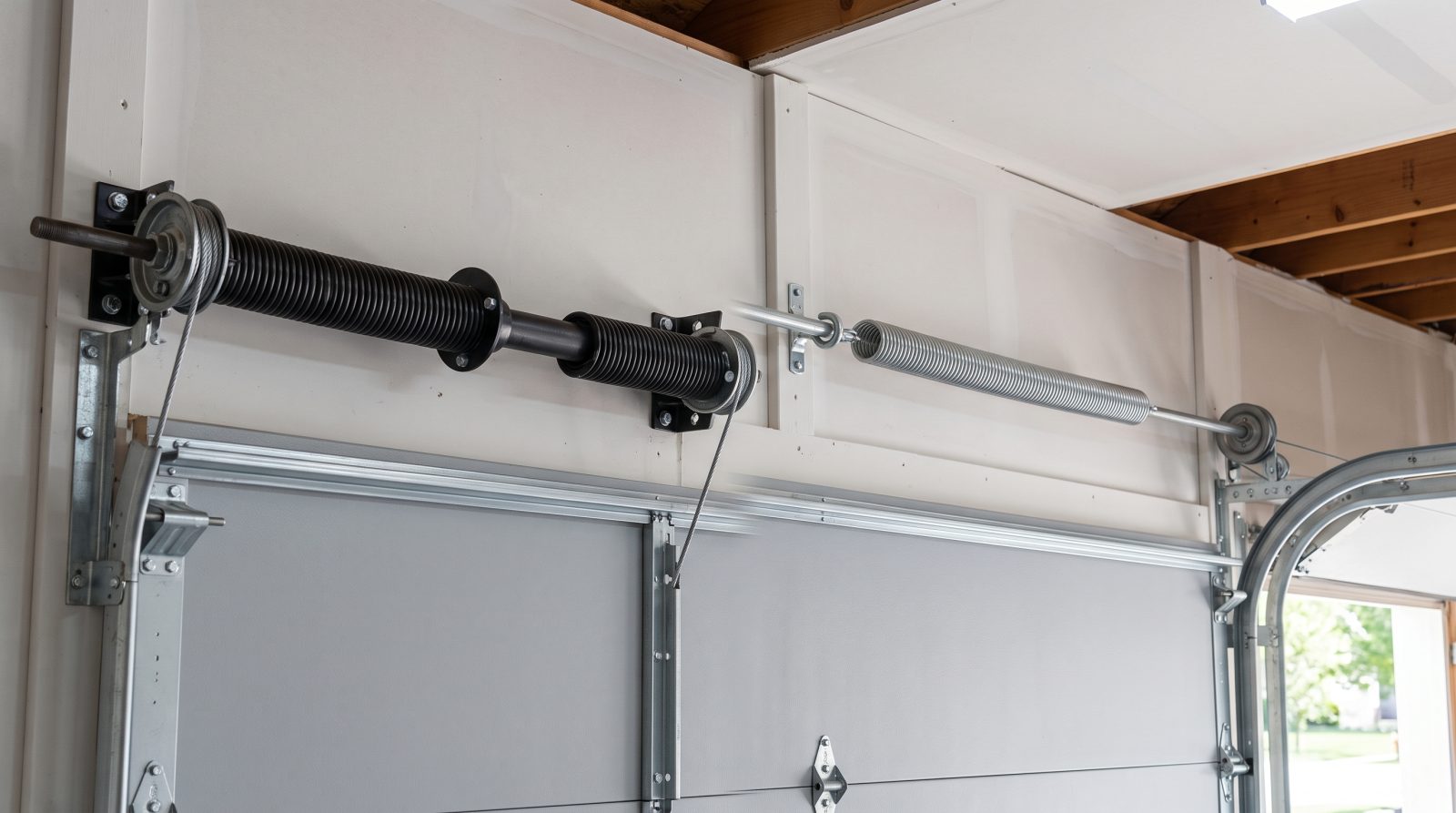
Torsion springs mount horizontally on a metal shaft above the closed door, usually anchored to a center bracket over the header. When the door comes down, the shaft winds the spring tight; when the door goes up, the spring unwinds, releasing torque that turns drums at each end of the shaft and lifts the door with cables. Because the force is delivered as a smooth, controlled rotation, torsion systems tend to lift evenly and feel balanced through the whole travel of the door.
Extension springs are the long, lighter springs that stretch out along the horizontal tracks on either side of the door, parallel to the ceiling. They work by extension and contraction, pulling the door up as they contract and stretching out as the door closes. They're paired with pulleys and cables, and on any modern install they should be threaded with a safety cable through the center, a detail that matters enormously for the reasons covered below.
- Torsion: horizontal shaft above the door, winds and unwinds, lifts via drums and cables, smooth balanced travel
- Extension: springs alongside the upper tracks, stretch and contract, lift via pulleys and cables, more visible moving parts
- Both are precisely matched to your specific door weight, height, and track radius, which is why a generic off-the-shelf spring often is not the right one
- Both store a large amount of mechanical energy under tension, which is what makes spring work genuinely dangerous to attempt blind
Lifespan, Cycles, and Why Sacramento Conditions Matter
Garage door springs aren't rated in years, they're rated in cycles, where one cycle is a full open-and-close. A standard spring is commonly rated around 10,000 cycles, which sounds like a lot until you do the math: a busy household that opens the door six to eight times a day can burn through that in roughly four to seven years. Homes where the garage door is the main entrance, common in Sacramento's suburban neighborhoods like Natomas, Elk Grove, and Rancho Cordova, cycle their springs far more than a household that mostly uses the front door.
High-cycle springs (rated 20,000 cycles or more) cost more up front but can roughly double service life, which often makes them the better value for a primary-entry door. Torsion systems generally outlast extension systems in cycle life and tend to age more gracefully because the load is shared smoothly across the coil.
Sacramento's climate adds its own wear. Long, hot Central Valley summers bake the spring's protective coating and can accelerate fatigue, while the temperature swing between a 100-plus-degree afternoon and a cool Delta-breeze night makes the steel expand and contract repeatedly. Older detached garages in established areas, think Curtis Park, East Sacramento, and parts of Carmichael, often still run on original or undersized springs with little or no rust protection, which is why we see so many failures after the first real heat wave each year.
- Springs are rated by cycles (open + close), not by calendar age
- Standard rating is often around 10,000 cycles; high-cycle springs can be rated 20,000+
- A primary-entry door in a busy Sacramento household can reach a standard spring's limit in roughly 4 to 7 years
- Heat, big day-to-night temperature swings, and humidity from winter rains all speed up metal fatigue and corrosion
- If one spring on a two-spring door has failed, the matching one is usually close behind
Safety: Why Spring Work Is the One Repair to Leave Alone
This is the part we never soften. Both spring types are under enormous tension, storing the same energy it takes to lift hundreds of pounds. When a torsion spring is wound or unwound incorrectly, the winding bars can become projectiles; when an extension spring snaps without a safety cable, the spring itself can whip across the garage with real force. Serious injuries from DIY spring jobs are common enough that this is genuinely the single most dangerous part of a residential garage door.
Extension springs carry a specific, avoidable hazard: if there's no safety cable run through the center of the spring, a break can send the spring flying. Any modern, correctly installed extension system has these cables. If your springs run along the side tracks and you can't see a cable threaded through them, that's a finding worth a professional look, regardless of whether the spring has failed yet.
Torsion work demands properly fitted winding bars and exact turn counts matched to the door's weight; guessing or using the wrong tools is how people get hurt. There's also a balance dimension to safety: a door running on a worn or mismatched spring forces the opener to strain, wears the gears, and can let the door drop faster than it should. The safe and frankly cheaper path is to have springs measured, matched, and replaced by someone who does it daily, which is exactly the kind of call we handle at your home.
- Springs store enough energy to lift a 150 to 350 pound door, all of it released at failure
- Extension springs without a center safety cable can become a flying hazard when they snap
- Torsion springs require correct winding bars and exact, weight-matched turn counts
- A worn or wrong-size spring overworks the opener and can let the door fall too fast
- Spring replacement is the clearest case for professional, mobile service rather than DIY
Which Spring Do You Have, and Which Is Right for Your Door?
Identifying your system takes about ten seconds and a quick look with the door closed. Look directly above the door, against the wall just over the opening. If you see one or two springs wound around a horizontal metal shaft running the width of the door, you have a torsion system. If instead you see longer, more loosely coiled springs running along the upper horizontal tracks on the left and right, stretched parallel to the ceiling, you have extension springs.
Which type is right depends on the door and the space. Torsion is generally the stronger, longer-lasting, better-balanced choice and is well suited to heavier insulated doors and to double-car doors, common on Sacramento's newer tract homes. The trade-off is that it needs adequate headroom above the door for the shaft and is a more involved install. Extension springs can be the right call where headroom is tight, on lighter single-car doors, and on many older Sacramento garages that were originally built around them, and they're often less expensive to replace.
On a two-spring door, replacing both at once is standard practice even if only one has visibly failed, because the surviving spring has logged the same cycles and will likely fail soon, often leaving you stranded a second time. Matching the spring to the door's true weight and travel is what separates a smooth, quiet door from one that struggles, and getting that match right is the core of a proper diagnosis. Because we're a mobile operation, we bring that diagnosis and the replacement parts to your driveway and aim for same-day service across the Sacramento area.
- Look above a closed door: springs on a horizontal shaft = torsion; springs along the side tracks = extension
- Torsion suits heavier insulated and double doors and lasts longer, but needs headroom
- Extension suits lighter or low-headroom doors and is often cheaper to replace
- Replace both springs together on a two-spring door to avoid a repeat failure
- A correct weight-and-travel match is what makes the door balanced, quiet, and easy on the opener