What a carriage house garage door actually is
The name comes from the side-hinged doors that once enclosed horse-drawn carriages. They swung open from the center on hinges. Today, almost no homeowner wants to manually swing two heavy doors open every time they leave for work, so the modern carriage house door keeps the look but works like any other sectional overhead door: it rolls up on tracks and runs off a standard opener and remote. You get the charm of the old style with the daily convenience of the new one.
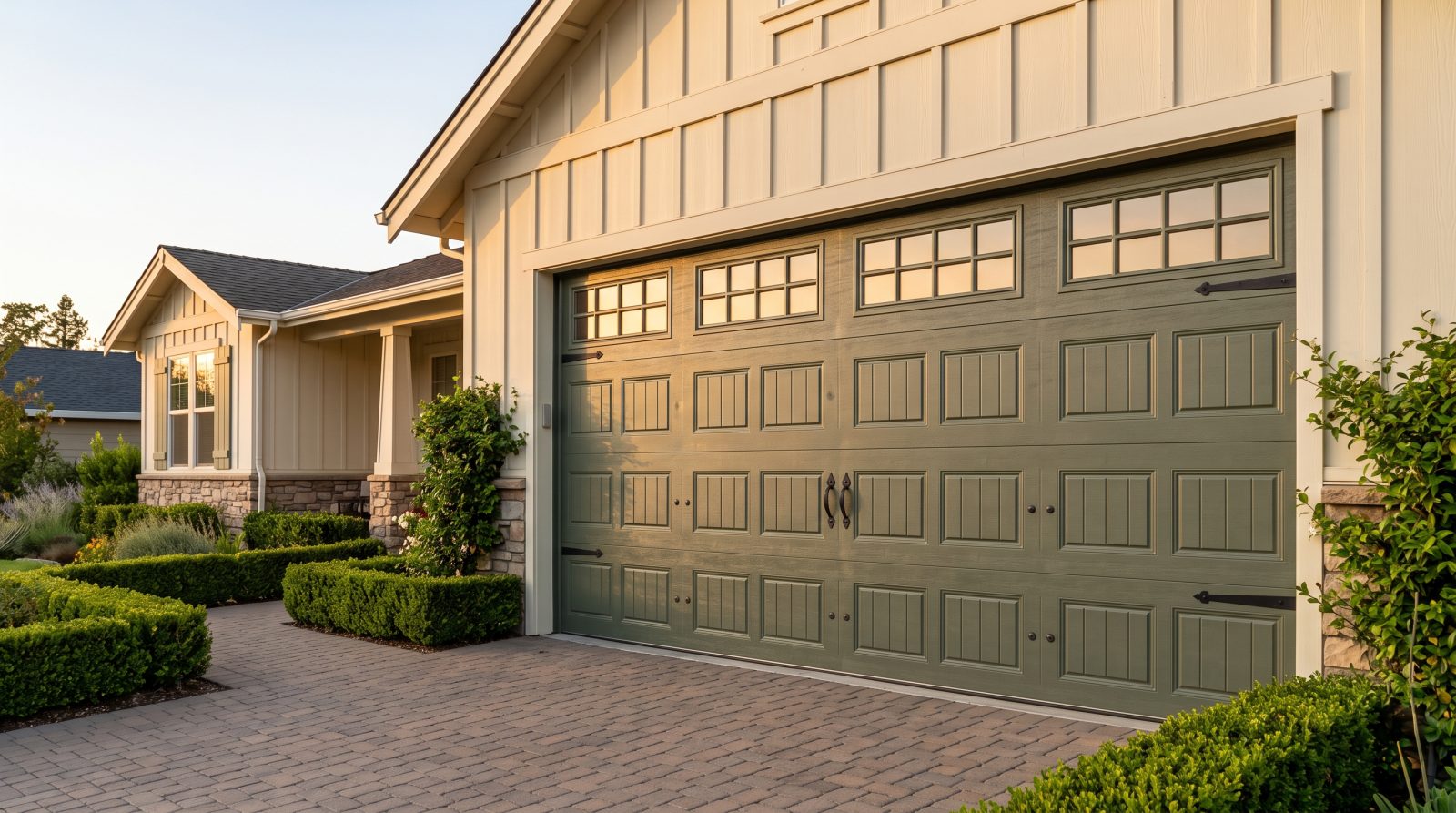
The carriage character comes from the details rather than the mechanism. Decorative hardware such as strap hinges and pull handles sits on the face of the door, the panels are divided into a symmetrical layout that mimics two swinging halves, and the top section often carries a row of windows. Some doors are flat and clean for a more transitional look, while others have heavy raised panels and a planked, woodgrain texture for a true rustic feel. Because it is the appearance and not the operation that defines the style, you can get a carriage look in nearly any material and price point.
- Looks like side-hinged swing doors but operates as a normal roll-up overhead door
- Decorative hardware (strap hinges, handles) creates the signature carriage detail
- Available with or without a top row of windows for natural light and curb appeal
- Works with your existing opener and remote, no special equipment required
Materials: steel, composite, and real wood for the Sacramento climate
The material you choose drives both the look and how the door ages in our climate. Steel carriage doors are the most common choice. They are typically built with one to three layers and an insulated core, they resist warping, and high-quality versions use factory-applied woodgrain finishes that read convincingly as wood from the curb. For most Sacramento homeowners, an insulated steel carriage door is the practical sweet spot: it gives the style, it handles the heat, and it asks very little of you in upkeep.
Composite and faux-wood overlay doors layer a wood-look skin over a stable core, giving you a warmer, more textured appearance than steel without the maintenance of solid timber. Real wood carriage doors, often built from cedar or hemlock, deliver the most authentic look and are popular on higher-end remodels in neighborhoods like Land Park and the Fab Forties. The trade-off is honesty here: real wood in Sacramento takes a beating from intense west-facing afternoon sun and seasonal swings between dry summer heat and damp winters, so it needs periodic refinishing to stay looking its best. We will walk you through that commitment before you buy so there are no surprises.
- Insulated steel: best all-around value, low maintenance, handles Valley heat well
- Composite / faux-wood overlay: warmer texture, stable core, modest upkeep
- Real wood (cedar, hemlock): most authentic, premium look, needs regular refinishing
- West and south-facing doors take the most sun, consider lighter colors and UV-stable finishes
Curb appeal and resale in Sacramento neighborhoods
In many Sacramento homes the garage door is the single largest visible element on the front elevation, often bigger than the front door and most of the windows combined. That makes it one of the few upgrades where a homeowner can change the whole character of a house from the street with one project. Swapping a plain flat door for a carriage-style door with windows and hardware is a common move for sellers and for owners who simply want their house to stop blending in with the rest of the block.
Style choice should follow the architecture. Older bungalows and Craftsman homes in Curtis Park, Oak Park, and East Sac tend to look right with planked, woodgrain carriage doors and simple square or arched window inserts. Mediterranean and Spanish-influenced homes pair well with darker stained looks and wrought-iron-style hardware. Newer tract homes in Elk Grove, Natomas, and Rancho Cordova can go either rustic or clean-transitional depending on the trim and paint. Because we are mobile, we hold sample sections up against your actual siding, stucco, and trim color in your own daylight, which removes most of the guesswork that leads to a door that looked great in a brochure but wrong on the house.
- The garage door is often the biggest single feature on a Sacramento front elevation
- Match the style to the architecture: planked/woodgrain for Craftsman, stained for Mediterranean
- We bring samples to your driveway so you choose against your real paint and light
- A windowed carriage door adds daylight to the garage and depth to the facade
Insulation, heat, and quiet operation
Sacramento summers regularly push well past 100 degrees, and an attached garage with an uninsulated single-layer door turns into an oven that radiates heat into the rooms next to it. If your garage shares a wall with a bedroom or office, or if you use it as a gym, workshop, or laundry space, insulation matters as much as looks. Insulated carriage doors are built with a polystyrene or polyurethane core sandwiched in the panels, which slows heat transfer, takes the edge off the afternoon bake, and helps keep conditioned air where you want it.
Insulation does more than manage temperature. A multi-layer insulated door is noticeably more rigid and quieter than a thin single-layer door, so it rattles less on the tracks and opens and closes with a more solid, muffled sound, something you appreciate on an early departure when the rest of the house is asleep. When we quote a carriage door we will talk through R-value options in plain terms and match them to how you actually use the space, rather than upselling insulation you do not need on a detached garage you rarely heat or cool.
- Uninsulated doors let attached garages radiate Valley heat into living spaces
- Polystyrene or polyurethane cores slow heat transfer and improve comfort
- Multi-layer insulated doors are stiffer, quieter, and rattle less
- We match R-value to how you use the garage, no unnecessary upsell
Cost ranges, installation, and ongoing care
Pricing for carriage house doors varies widely with material, insulation, window inserts, hardware, and whether your opening is a standard single, a standard double, or a custom size. As a general industry guide, an insulated steel carriage-style door installed tends to fall in the mid four-figure range for a typical double-car opening, faux-wood and composite overlays run higher, and true custom wood doors sit at the top of the range. These are labeled ranges to set expectations, not a quote, we measure your actual opening and give you firm numbers before any work begins.
A proper install is more than hanging panels. We check and adjust the springs and counterbalance to the new door's weight, since a heavier insulated or wood door needs the right spring system to open safely and to keep your opener from straining. We confirm the tracks, rollers, and safety reverse are all sound, and we haul away the old door. From there, carriage doors are easy to live with: keep the decorative hardware and tracks free of grime, lubricate the moving parts a couple of times a year, and on real-wood doors plan for periodic refinishing to fight our strong sun. If anything ever sticks, sags, or gets noisy down the road, we come back out, the same mobile service that installed it also repairs it.
- Costs are labeled industry ranges, not quotes; insulated steel is typically the value pick
- Custom sizes, windows, and hardware all move the price, we measure before quoting
- Springs and counterbalance are re-set to the new door's weight for safe operation
- Same-day mobile service for future repairs, we install it and we maintain it