How Your Garage Door Spring Actually Works
Most people assume the motor lifts the door. It does not. The opener only provides the small nudge needed to get a properly balanced door moving; the real lifting power comes from the springs. They store mechanical energy as you close the door and release it as you open, counterbalancing a panel that can weigh anywhere from roughly 130 pounds on a single-car steel door to well over 350 pounds on an insulated double or a custom wood door common in older Sacramento neighborhoods like East Sac and Curtis Park. Without functioning springs, that full weight lands on the opener, the cables, and eventually you.
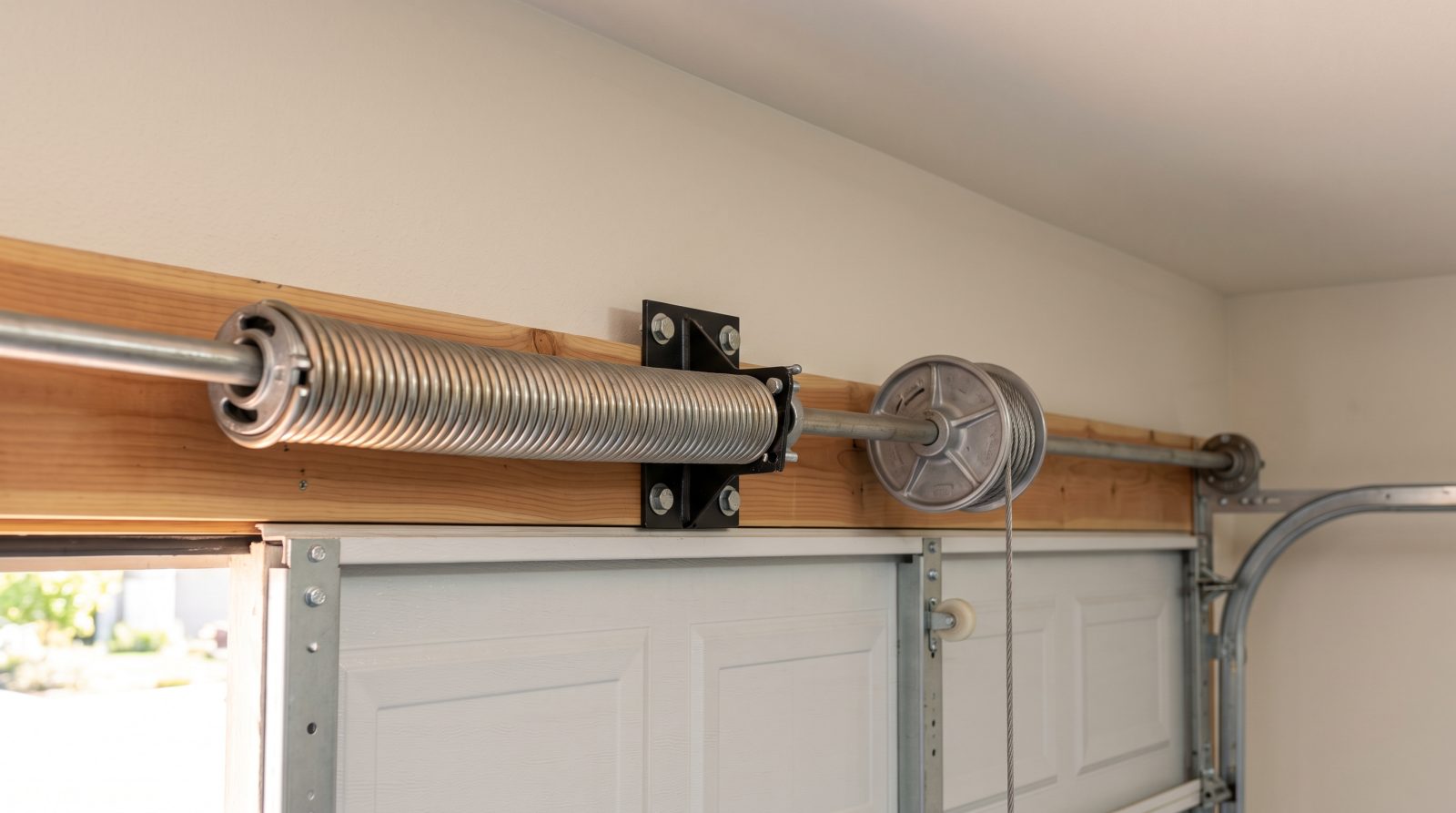
There are two systems you will encounter in the Sacramento area. Torsion springs mount on a metal shaft above the door opening and wind tightly as the door lowers; they are the modern standard and are found on most homes built or re-doored in the last two decades. Extension springs run along the horizontal tracks on either side of the door and stretch as the door closes; they are common on older two-car garages throughout the region. The repair, the parts, and the safety cabling differ between the two, which is why an accurate on-site diagnosis matters more than a generic part swap.
- Torsion springs: mounted on a shaft above the door, wind under torque, longer-lived, safer when properly installed
- Extension springs: mounted along the side tracks, stretch and contract, should always have a containment safety cable threaded through them
- The opener does not lift the door; the springs do almost all of the work, so a snapped spring will overwork or stall a healthy motor
- Door weight and spring size must be matched precisely; an undersized or oversized spring throws the whole system out of balance
Why Garage Door Springs Break in Sacramento
The most common cause is simply cycle fatigue. Springs are rated by cycles, with a standard spring commonly rated around 10,000 cycles, where one cycle is a single up-and-down. A household that opens the door four to six times a day will reach that range in roughly seven to nine years. Many Sacramento garages serve as the primary entrance to the home, so the door cycles far more than the owner realizes, and a spring that 'just broke' was usually at the end of a long, predictable life.
Local conditions accelerate the wear. Sacramento's hot, dry summers and cool, damp winter mornings create a temperature swing that contributes to micro-fractures in the steel and lets surface rust take hold on uncoated springs, especially in homes closer to the Delta and the rivers where morning humidity sits in the garage. Mineral dust, lack of lubrication, and dust buildup from our dry summers all add friction that shortens spring life. A spring often lets go in cold morning air, when the metal is most brittle, which is why many failures happen on the first open of the day.
Other failures trace back to the original install or to neglected maintenance: a door that should have a dual-spring setup but was fitted with a single spring, mismatched spring sizes left and right, corrosion on a spring that was never lubricated, or a door that was forced open after coming off-balance. Recognizing the warning signs early can turn an emergency into a scheduled fix.
- Cycle fatigue: standard springs are commonly rated near 10,000 cycles and naturally wear out, often in the seven-to-nine year range for a busy door
- Temperature swings: Sacramento's hot summers and cold, damp winter mornings stress the steel and can trigger a break on the first cold open
- Rust and lack of lubrication: dry-summer dust plus winter moisture corrode springs that are never maintained
- Improper original setup: single spring where two belong, or mismatched left/right spring sizes that fail early
- Warning signs to watch: a loud bang from the garage, a two-to-three inch gap in the spring coil, a door that lifts crooked or only a few inches, or an opener that strains and stops
The Safety Reality: Why This Is Not a DIY Repair
A wound torsion spring stores an enormous amount of energy in a small space. When you unwind or replace one, that energy has to be controlled with proper winding bars and technique. Using the wrong tool, a screwdriver, or a pair of pliers is how people lose fingers, break hands, and take a steel bar to the face. This is the repair where the difference between a trained technician and a confident weekend warrior is measured in trips to the emergency room.
There is also a hidden trap with a broken spring: the door is now dead weight. If you disconnect the opener and try to lift it by hand, or if the cables are still partially loaded, the door can drop suddenly and crush whatever is underneath, fingers, feet, a car hood, or a child. Once you suspect a broken spring, the safest move is to stop using the door entirely, avoid forcing the opener, and keep people and vehicles out from under it until a technician can secure and balance it.
When our mobile technician arrives, the process is methodical and safe: we secure the door, release tension in a controlled way, verify the correct spring size against the door's actual weight, install the matched replacement, re-thread or replace safety cables on extension systems, wind to the correct turns, then test and fine-tune the balance so the opener is no longer fighting the door. Doing it right protects both you and the longevity of the new parts.
- Wound springs store high tension; only proper winding bars and technique safely control it
- Once a spring breaks, treat the door as dead weight: stop using it and keep people and cars clear
- Do not run the opener against a broken spring; you can burn out the motor or snap a cable
- A correct repair includes verifying spring size against true door weight, replacing safety cables where needed, and re-balancing the door
What Our Mobile Spring Repair Includes
Because we are a mobile, we-come-to-you operation, you do not haul a heavy door panel anywhere or wait for a storefront to open. We bring common torsion and extension spring sizes, winding bars, cables, and balancing tools directly to your driveway anywhere in the Sacramento service area. The visit starts with a real diagnosis, not a guess: we confirm whether the spring is truly the failed part or whether a cable, drum, or bearing is the actual culprit, because replacing a spring on a door with a deeper problem just sets up the next failure.
A thorough spring repair is more than swapping one coil. On a two-spring torsion system, when one spring breaks the other is usually near the end of its own life, so we will explain the tradeoff of replacing both at once to avoid a second service trip within months. We also inspect the cables, end bearings, center bearing, and rollers while the door is secured, lubricate the moving parts, and re-balance the door so it floats smoothly and the opener is no longer carrying load it was never designed to carry.
We work on torsion and extension setups, single and double doors, and the older custom and wood doors found across established Sacramento neighborhoods. Every repair finishes with a hands-on test: we cycle the door, check that it holds at the halfway point, confirm the auto-reverse safety responds, and make sure you can operate it manually and by remote before we leave.
- Mobile service that comes to your driveway anywhere in the Sacramento area, no need to move the door
- Honest diagnosis that confirms the spring, not a cable or bearing, is the real failure before any parts go in
- Option to replace both springs on a dual-spring door to avoid a repeat failure within months
- Full safety check: cables, bearings, rollers, lubrication, and a balanced door that the opener can move easily
- Final hands-on test of balance, auto-reverse safety, and both manual and remote operation
What Spring Repair Typically Costs and How to Decide
Garage door spring repair pricing varies with the type of system, the spring size your door requires, and whether you replace one spring or both. As a general industry range, spring replacement commonly falls somewhere in the low-to-mid hundreds of dollars for parts and labor combined, with a single torsion spring on a standard door at the lower end and a heavier dual-spring or specialty setup toward the higher end. These are labeled industry ranges to help you plan, not a quote; the only accurate number comes from confirming your exact spring size and door weight on site, which is why we provide a free quote before any work begins.
The smart way to decide is to weigh the cost of doing it once and correctly against the very real safety and re-injury risk of a partial or DIY fix. If your door is more than seven years old and on its original springs, replacing both springs and refreshing the worn hardware at the same time is often the better long-term value than a single-spring patch that leaves an aging twin ready to fail. Our technician will lay out the options clearly so you choose with full information.
If your door is down right now, the priority is safety and getting you back to a working, balanced door, often the same day. Call or request a free quote and we will get a mobile technician headed your way with the parts to handle most common Sacramento spring failures on the first visit.
- Cost drivers: torsion vs extension, exact spring size, door weight, and one spring vs both
- Industry ranges help you plan; an accurate price requires confirming your door's actual spring size on site
- Replacing both springs on an older door often beats a single-spring patch that fails again soon
- Free quote before work begins, with same-day repair available for many common spring failures