Why Sacramento's Climate Is Hard on Garage Doors
Sacramento's Mediterranean climate puts a specific set of stresses on garage door hardware that homeowners in milder regions never deal with. Our long, intensely hot summers and our cool, damp winters force the door through a wide annual temperature swing, and every component, from the steel torsion spring to the rubber bottom seal, expands and contracts with it. That constant cycling is what loosens fasteners, dries out lubricant, and slowly cracks weatherstripping over a few seasons.
Summer heat is the big one. When afternoon temperatures climb past 100 degrees in neighborhoods like Natomas, Elk Grove, and Rancho Cordova, an attached garage with a metal door can turn into an oven. Heat thins and bakes off grease from rollers and hinges, and it can soften the rubber seal at the base of the door so it sticks to a hot concrete slab. Older steel springs also lose a small amount of tension as metal fatigues over thousands of hot-weather cycles.
Winter brings the opposite problem. The Delta breeze and tule fog push humidity up, and moisture is the enemy of bare steel. Springs, hinges, and the curved track sections start to develop surface rust, which makes the door run rough and noisy. Add the fine agricultural and road dust that blows across the Valley most of the year, and that grit mixes with old grease into a gritty paste that grinds away at rollers and bearings.
None of this means your door is fragile. It means a door in our climate benefits from a simple seasonal rhythm: lubricate and protect against heat going into summer, and clean, dry, and rust-check going into winter. Catch the small stuff early and you rarely face the big stuff.
- 100-degree-plus summers bake grease off rollers and hinges and can warp or fade door panels
- Damp winters and tule fog promote surface rust on springs, hinges, and tracks
- Year-round Valley dust mixes with old lubricant into an abrasive paste
- Wide annual temperature swings loosen fasteners and crack rubber weatherstripping
- Attached garages with metal doors trap radiant heat, accelerating wear in summer
The Spring & Summer Checklist (Beat the Heat)
Spring is the ideal time to prepare your door for the brutal stretch ahead. The goal heading into a Sacramento summer is to make sure everything is clean, properly lubricated with a heat-tolerant product, and sealed against the heat. Plan on 30 to 45 minutes on a cool morning before the garage warms up.
Start with a visual and listening inspection. Open and close the door a couple of times and just watch and listen. A door that screeches, grinds, jerks, or hesitates is telling you something is dry, loose, or worn. Look at the rollers as the door moves; they should roll, not slide, and they should not wobble in their stems.
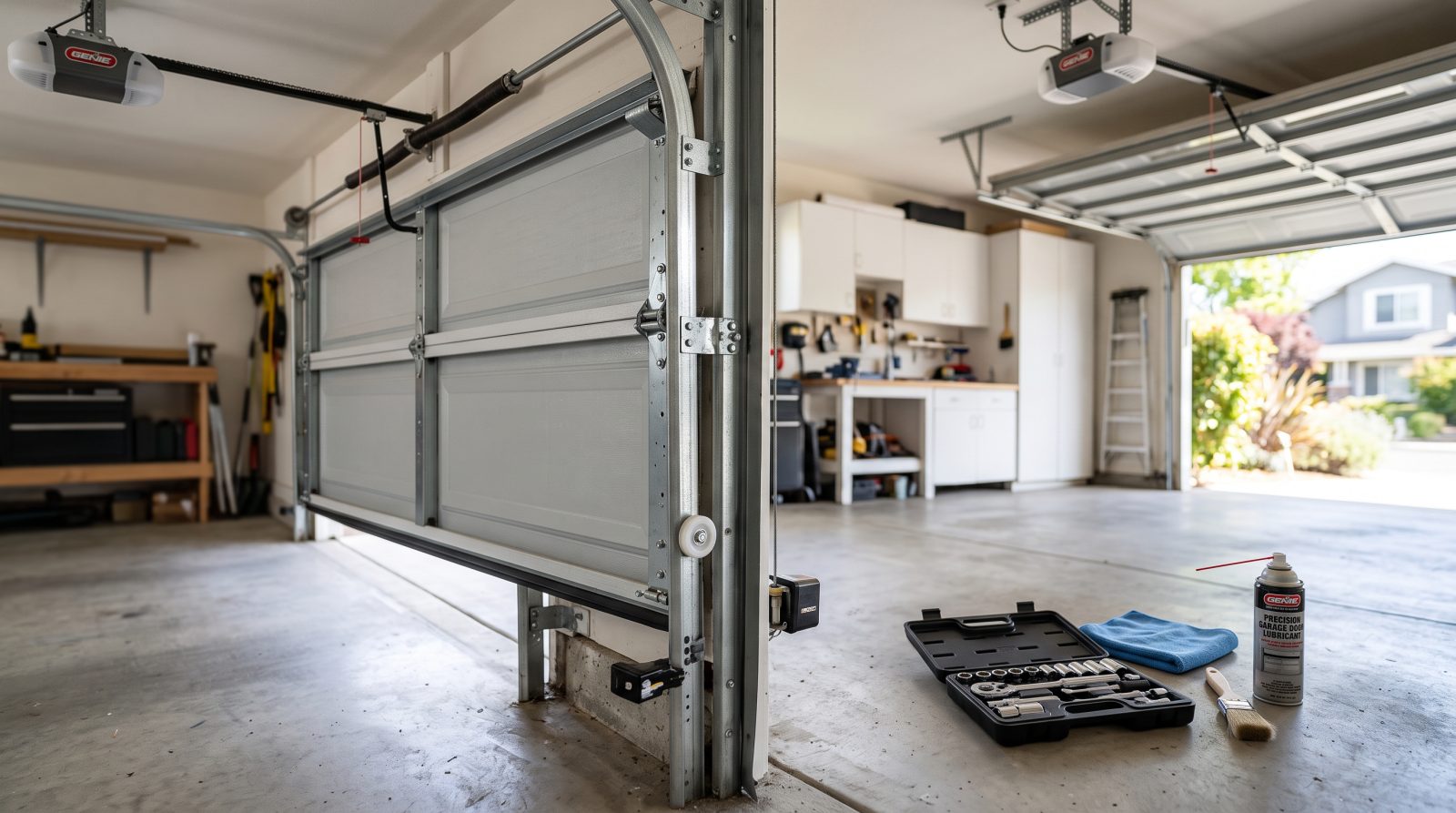
Lubrication is the highest-value task you can do. Use a garage-door-specific silicone or lithium-based spray lubricant, not WD-40, which is a cleaner and degreaser, not a long-term lubricant, and will actually leave hardware drier over time. Apply a light coat to the rollers (the bearings, not the nylon wheel face), the hinges, and the springs, then wipe up any drips. In our heat, re-check lubrication mid-summer because high temperatures thin it out faster.
Finish by checking your weather seals. The bottom rubber gasket and the perimeter weatherstripping take a beating from UV and heat. If the bottom seal is cracked, flattened, or no longer touches the slab evenly, replacing it keeps hot air, dust, and the occasional summer pest out of the garage and helps any cooling you run in there.
- Watch and listen to a full open/close cycle; note any grinding, jerking, or hesitation
- Lubricate rollers, hinges, and springs with silicone or lithium spray (never WD-40 as a lubricant)
- Tighten roller brackets, hinge bolts, and track fasteners with a socket wrench (snug, not over-torqued)
- Inspect the bottom rubber seal and perimeter weatherstripping for UV cracking and flattening
- Wipe dust and grit off the tracks with a damp rag; do not grease the inside of the tracks
- Re-check lubrication mid-summer since extreme heat thins it out quickly
The Fall & Winter Checklist (Fight Moisture & Rust)
As the fog and rain roll in, your maintenance focus shifts from heat to moisture. The enemy in winter is rust and grit, and a little prevention keeps your door from turning into a noisy, sluggish mess by spring. Fall is also when many people use the garage more for storage and projects, so a smooth, sealed door matters even more.
Begin by cleaning the tracks and hardware. Wipe down the vertical and curved track sections with a dry or barely damp rag to remove the summer's accumulated dust before it can trap moisture against the metal. Look closely at the springs and hinges for any orange surface rust starting to form. A light coat of the same silicone or lithium lubricant after cleaning gives bare metal a protective film through the wet months.
Check your weatherstripping again, this time for sealing against rain and the cold Delta breeze. The bottom seal should make full, even contact with the slab so wind-driven rain does not pool under the door. If your garage feels noticeably drafty or you see daylight along the edges when the door is shut, refreshing the perimeter seal makes the space more comfortable and protects whatever you store in there.
Finally, listen for the cold-weather symptoms that point to spring trouble. Doors often feel heavier and run rougher in cold, damp weather, and that is precisely when a tired torsion spring is most likely to fail. If the door struggles to lift, bangs at the top, or one side rises faster than the other, stop using it and have it looked at before it breaks.
- Clean dust and debris off all track sections before winter moisture sets in
- Inspect springs, hinges, and tracks for early surface rust and apply a protective lubricant film
- Confirm the bottom seal makes full contact with the slab to block wind-driven rain
- Refresh perimeter weatherstripping if you see daylight or feel drafts around a closed door
- Watch for cold-weather warning signs: a heavy, struggling, or uneven door points to spring fatigue
The Year-Round Safety Tests Every Homeowner Should Run
Beyond seasonal upkeep, there are two safety tests worth running every month regardless of the season. They take about five minutes combined and they are the difference between a door that protects your family and one that becomes a hazard. These are the checks every homeowner should know about.
The balance test tells you whether your springs are doing their job. With the door closed, pull the red emergency release cord to disconnect the opener, then lift the door by hand to about waist height and let go. A properly balanced door will stay put or drift only slightly. If it slams down or shoots up, the spring is out of tension and your opener is straining to compensate, which shortens its life and signals a spring that may be near failure. Springs are under extreme tension and are the one component you should never adjust yourself.
The auto-reverse test confirms your safety mechanisms work. Most modern openers have two: a mechanical reverse and photo-eye sensors. Place a solid object like a roll of paper towels or a 2x4 flat on the floor in the door's path and close it; the moment the door touches the object it should stop and reverse. Then test the photo eyes by closing the door and waving your foot through the beam near the floor. The door should immediately reverse without touching anything.
If either safety test fails, treat the door as unsafe and stop using the automatic operation until it is fixed. Photo-eye misalignment is often a simple adjustment, but a failed reverse on contact needs prompt attention, especially in households with kids or pets.
- Balance test: disconnect the opener and hand-lift the door; it should hold near waist height
- Auto-reverse test: the door must stop and reverse the instant it contacts an object on the floor
- Photo-eye test: the door must reverse when something breaks the beam near the floor
- Keep the photo-eye lenses clean and aligned; dust and bumps are common causes of failure
- Never adjust or remove a torsion or extension spring yourself; the stored tension can cause serious injury
DIY vs. When to Call a Mobile Technician
Knowing where the DIY line sits keeps you safe and saves money. Cleaning, lubricating, tightening visible fasteners, replacing weatherstripping, and running the monthly safety tests are all squarely in homeowner territory. They are low-risk, require only basic tools, and make up the bulk of what keeps a door healthy.
Some jobs are not DIY. Anything involving the torsion or extension springs, the lifting cables, or a door that has come off its tracks involves components under tremendous tension or load, and these are the source of most serious garage door injuries. The same goes for a bent track, a cracked panel, a failed opener gearset, or a door that is badly out of balance. These need the right tools, the right replacement parts, and the experience to do them safely.
Because we are a fully mobile garage door company serving the greater Sacramento area, you do not have to haul anything anywhere. We bring the parts and tools to your driveway, whether you are in Midtown, Folsom, Roseville, Citrus Heights, West Sacramento, or out toward Elk Grove. That matters with a broken door, because a door stuck open is a security risk and a door stuck closed can trap your car inside the garage.
A good rule of thumb: if a task involves a spring, a cable, the opener's internal mechanism, or anything making the door feel heavy or dangerous, it is time to call. If you have run through your seasonal checklist and something still does not feel right, reach out and request a free quote and we will take a look. Catching a worn part during a routine tune-up is almost always cheaper than dealing with a full failure later.
- Safe to DIY: lubrication, cleaning, tightening visible bolts, seal replacement, safety tests
- Call a technician: spring and cable work, doors off the track, bent tracks, cracked panels, opener repairs
- Any door that suddenly feels heavy or unbalanced is a spring warning sign, not a DIY fix
- As a mobile company we come to you across the Sacramento area, so a broken door doesn't strand your car
- A same-day tune-up that catches a worn part usually costs far less than a full breakdown later