How Garage Door Lift Cables Actually Work
Most Sacramento homes have a sectional steel garage door balanced by either a torsion spring mounted on a shaft above the opening or a pair of extension springs running along the horizontal tracks. The lift cables are the link between those springs and the door itself. On a torsion system, the cable wraps around a grooved cable drum at each top corner and runs down to a bracket at the bottom of the door, so as the spring unwinds it turns the drums and the cables steadily lift the weight. On an extension system, the cables route through pulleys and let the springs stretch and contract as the door travels.
The cable is doing a balancing act every single time the door moves. When everything is set correctly, the springs carry the load and the cables simply guide and transfer that force, which is why a healthy door feels almost weightless by hand. When a cable stretches, slips off its drum, or breaks, that balance is lost instantly and the full weight of the door drops onto whatever is left, often the opener, the opposite cable, or the ground.
Because there are two cables working as a matched pair, they wear at a similar rate. That is why a broken or badly frayed cable is almost never an isolated event. The mate is usually close behind, which shapes how we approach a lasting repair rather than a quick patch.
- Torsion-spring doors use cable drums at the top corners; extension-spring doors use pulleys
- Cables transfer spring force, they do not create lift on their own, so a cable issue often points back to spring health
- Lift cables and the springs they serve are under constant high tension whether the door is open or closed
- The two cables are a matched set and tend to fail within months of each other
Signs Your Cable Is Frayed or About to Snap
A failing cable rarely goes from perfect to broken without warning. Catching the early signs can turn a potential emergency into a routine same-day fix. The most common first clue is a door that no longer sits level. If one bottom corner hangs lower than the other or the door looks tilted in the opening, a cable has likely slipped, stretched, or started to come off its drum.
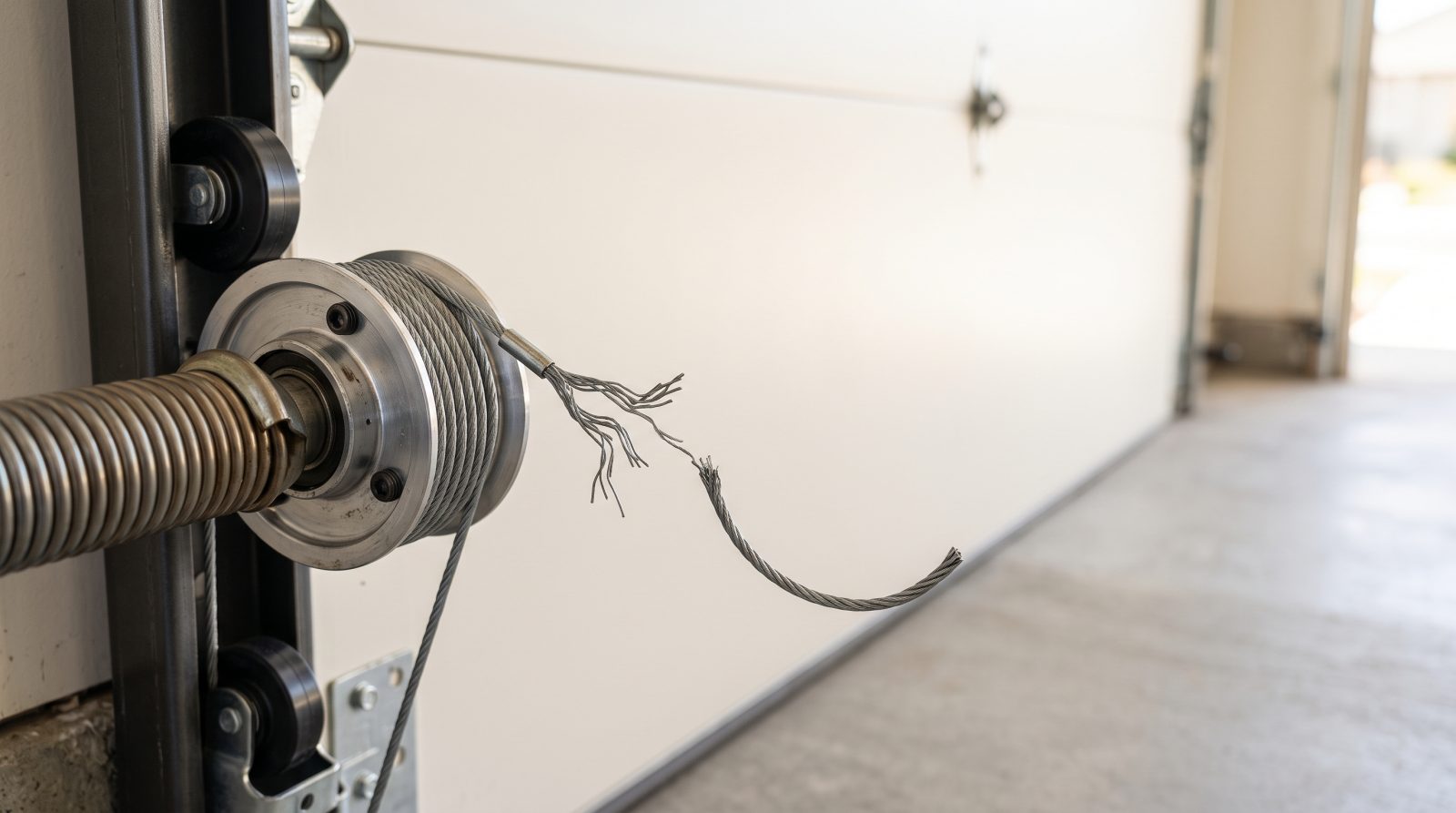
Look closely at the cable itself near the bottom brackets and at the top where it meets the drum. Healthy cable is smooth, tight, and evenly wound. Trouble shows up as rust, kinks, flattened spots, or stray wire strands sticking out like a wire brush, which is the classic frayed look. A cable that has come loose may pool or sag at the bottom of the track. You may also hear new sounds: a grinding, popping, or scraping noise as the door binds in the tracks because the two sides are no longer pulling evenly.
Heat plays a role in Sacramento. Long, hot Central Valley summers and detached or uninsulated garages that double as workshops and home gyms drive temperature swings and fine dust into the hardware, which accelerates rust and metal fatigue on cables that are already cycling thousands of times a year. If your door is getting harder to operate, catching, or shuddering as it moves, it is worth a look before a strand-by-strand fray becomes a full break.
- Door sits crooked or one bottom corner sags lower than the other
- Visible rust, kinks, flat spots, or stray wire strands (fraying) on the cable
- Cable hanging loose, slack, or pooled at the bottom of the track
- New grinding, popping, or scraping sounds as the door binds in the tracks
- Door suddenly feels heavier or jerky and the opener strains more than usual
Why a Broken Cable Is a Genuine Safety Hazard
It is tempting to treat a garage door cable like a worn shoelace, but the comparison is dangerous. These cables hold back hundreds of pounds of stored energy. When a cable snaps under load, the door can drop fast and hard, and the loose end can whip with real force. People have been seriously injured trying to muscle a door open after a cable failure, and pets, kids, and parked cars are directly in the drop zone.
A single broken cable also throws the whole door off balance. The remaining cable and the opener were never designed to carry the full weight alone, so continuing to run the door can bend tracks, snap the second cable, strip the opener gears, or crack a door panel, turning a modest cable repair into a much larger bill. Many openers will sense the imbalance and reverse, sometimes leaving the door stuck halfway with your car trapped inside or your home exposed overnight.
The most important safety rule is also the simplest: leave the springs alone. Cable repair is intertwined with high-tension torsion or extension springs, and adjusting or releasing those without the correct winding bars and technique is exactly how serious garage-door injuries happen. This is the part of the job we handle with the proper tools so you do not have to take that risk. If your cable has snapped, stop using the door, keep people and vehicles clear, and request a quote so a tech can come secure it safely.
- Snapped cables release stored spring energy and the door can fall fast
- A one-cable failure overloads the opener and the second cable, multiplying the damage
- Running an unbalanced door can bend tracks, crack panels, or strip opener gears
- Never try to adjust or release the springs yourself; that is where most injuries occur
- Stop operating the door and keep the area clear until it is professionally secured
How Our Mobile Cable Repair Works in Sacramento
Because we operate as a mobile, we-come-to-you service, there is no shop to drive to and no waiting for a part to ship. Our technician arrives at your home with cables in the common gauges, replacement drums and pulleys, and the winding tools needed to safely manage the springs while the cable is off. We start by inspecting the full system, not just the failed cable, so we can tell you whether it is a clean cable replacement or whether worn drums, a tired spring, or a misaligned track contributed to the failure.
A proper repair almost always means replacing both lift cables as a matched pair, even if only one has visibly failed, because the second is the same age and under the same stress. We safely capture spring tension, fit the new cables to the correct length and gauge for your door, seat them properly in the drums or pulleys, and then re-balance the door so the springs carry the weight the way they should. Before we leave, we cycle the door several times, check that it sits level, and confirm the opener engages smoothly.
We serve homeowners across the greater Sacramento area, including older neighborhoods like East Sacramento, Land Park, Curtis Park, and Tahoe Park where original mid-century doors and hardware are common, as well as newer tract developments in Natomas, Elk Grove, Folsom, Roseville, Rancho Cordova, and Citrus Heights. Whether you have a single bungalow door or a wide two-car steel sectional, we size and tension the cables to your specific door rather than a one-size guess. When you are ready, you can call or request a free quote and we will give you a same-day or fast-scheduled visit.
- Fully mobile: we bring cables, drums, pulleys, and spring-winding tools to your driveway
- We inspect the whole balance system, not just the broken cable, to find the real cause
- Both cables replaced as a matched pair and sized to the correct gauge and length for your door
- Door re-balanced and test-cycled so the springs carry the weight and the opener runs smoothly
- Serving homes across Sacramento, from older central neighborhoods to newer suburban garages
What Cable Repair Typically Costs and How to Avoid Repeat Failures
Pricing depends on your door, but it helps to understand the ranges. Across the garage door industry, replacing a pair of lift cables is generally one of the more affordable repairs, while jobs that also involve worn drums, pulleys, or a failed spring discovered during the inspection sit higher because more parts and labor are involved. Every door is different, so we give you a clear quote for your specific situation before any work begins rather than a vague number over the phone. Any figures here are general industry ranges, not a promise of price for your home.
The good news is that cable life is largely about maintenance and balance. Cables fail faster when a door is out of balance, because the cable ends up fighting the door weight instead of guiding it, and when rust and grit are allowed to build up on the hardware. A quick annual check, light lubrication of the moving parts, and keeping an eye on those early fraying signs go a long way in Sacramento's hot, dusty conditions.
If you use your garage as a primary entrance, you may be cycling the door several thousand times a year, which is normal but does wear cables and springs over time. When we replace your cables, we also confirm the spring balance and track alignment so the new cables start life under the right load. That is the single biggest factor in how long they last and the reason a proper repair tends to outlast a rushed one.
- Cable-pair replacement is usually a lower-cost repair; added drum, pulley, or spring work raises the range
- All figures here are general industry ranges, not a quote; we price your door before any work
- Most premature cable failures trace back to a door that is out of balance
- Annual inspection and light lubrication extend cable life in Sacramento's heat and dust
- We re-check spring balance and track alignment so new cables start under the correct load